Behind The Painting: The Virgin of the Rocks
Christmas imagery is often dominated by clarity and light. Gold haloes, clean interiors, idealised figures. Yet some of the most compelling images associated with Christ’s birth resist that visual comfort. They place the Nativity not in an ordered, glowing world, but in one that feels uncertain and materially grounded.
Leonardo da Vinci’s The Virgin of the Rocks is not a Nativity scene in the conventional sense. There is no stable, no star, and no sense of public witness. Instead, the painting presents a quiet encounter set within a rocky grotto. It is an image that lends itself to reflection at Christmas precisely because it avoids spectacle.
The Painting
Leonardo painted two versions of The Virgin of the Rocks between roughly 1483 and 1508. The earlier version hangs in the Louvre, Paris. The later version is in the National Gallery, London. While the compositions are similar, the differences matter.
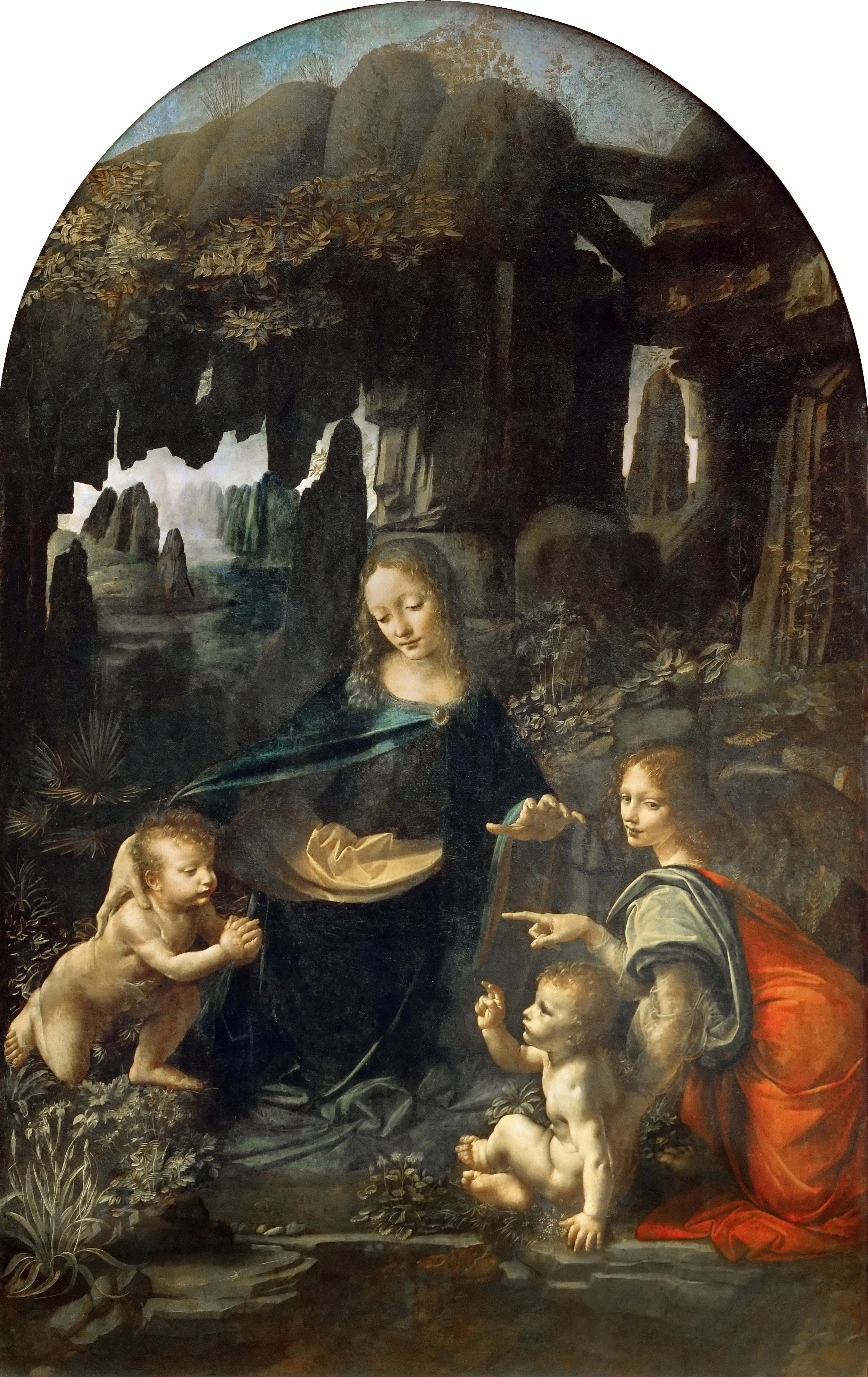
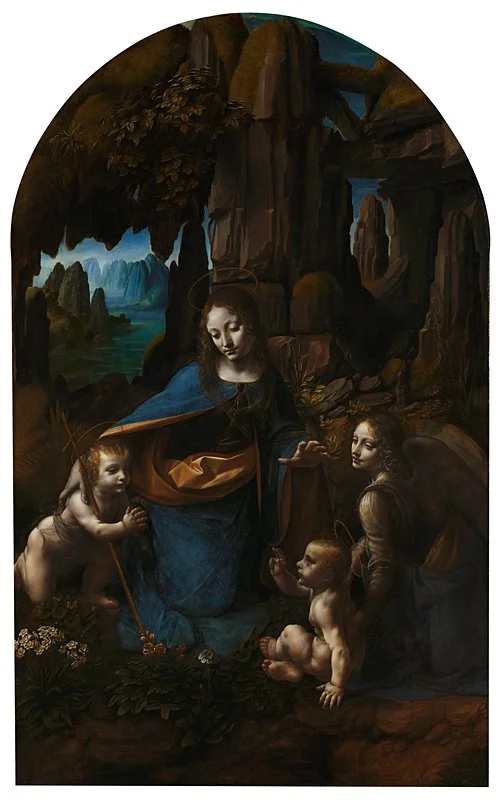
Both paintings show the Virgin Mary, the infant Christ, the young John the Baptist, and an angel gathered in a rocky grotto. The figures are arranged in a pyramidal composition, a structure that creates balance without rigidity. The children interact through gesture rather than speech or hierarchy. Christ raises his hand in blessing. John kneels in recognition. Mary’s hands hover protectively, never gripping, never withdrawing. In the later London version, haloes are added and John is given a cross. The plants are altered. The overall effect is more orthodox and more legible. The earlier Paris version is looser, darker, and more unsettling. It is also the version where Leonardo’s intentions feel least constrained.
Neither painting depicts the Nativity directly. Instead, they reference an apocryphal story in which Christ and John meet as children while fleeing the Massacre of the Innocents. This narrative choice already shifts the emphasis away from public revelation and toward private encounter.
The most striking feature of The Virgin of the Rocks is not a figure, but the setting. The figures are placed inside a cave-like landscape formed of jagged stone, shadowed recesses, and still water. This is not a backdrop. It is an active presence. Caves carry layered meaning. They can suggest shelter, danger, origins, or burial. Leonardo exploits this ambiguity. The grotto feels protective but unstable. The figures are safe for now, but nothing in the environment promises permanence.
This choice reflects Leonardo’s sustained interest in geology and natural process. He studied rock formations, erosion, and fossils with the same seriousness he applied to anatomy. In his notebooks, he questioned the Church’s explanation for seashells found high in mountains, rejecting the idea that they were carried there by a single biblical flood. Instead, he argued that the Earth had changed slowly over immense time.
Placing Christ’s early life inside a geological space shaped by time, pressure, and change is not neutral. It embeds the divine within the natural world rather than lifting it above it. Birth, here, happens inside history, not outside it.
The Artist
Leonardo was not a theologian in the conventional sense. His primary loyalty was to observation. He trusted what he could see, record, and test. This did not make him irreligious, but it did make his faith unconventional. His notebooks reveal sustained attention to geology, botany, and the behaviour of water. He was sceptical of inherited explanations that failed to align with what he could see for himself. Fossils embedded in mountains, the structure of shells, and the erosion of rock all informed his understanding of time and nature.
This interest is not incidental to The Virgin of the Rocks. The landscape is not decorative. It reflects Leonardo’s belief that nature is active, structured, and meaningful. By situating the holy figures within a geological space shaped by time and pressure, he aligns spiritual significance with the material world rather than setting it apart.
This approach was unusual in religious painting of the period. Sacred figures were often placed within idealised architectural or symbolic settings. Leonardo instead gives us stone, water, and shadow. The effect is not dramatic, but deliberate.
Historical Context
The painting was commissioned in 1483 for an altarpiece for the Confraternity of the Immaculate Conception in Milan. The subject matter relates to an apocryphal story in which the infant Christ and John the Baptist meet while fleeing the Massacre of the Innocents.
Despite this doctrinal context, Leonardo avoids clear visual statements about the Immaculate Conception. There are no obvious symbols asserting Mary’s purity. This absence caused friction with the commissioning body and likely contributed to disputes over payment and the need for a second version of the painting.
Rather than emphasising doctrine, Leonardo focuses on relationship and environment. The holiness of the scene is conveyed through care, protection, and attention rather than through overt religious markers.
A Christmas Reading
Seen through a Christmas lens, The Virgin of the Rocks presents birth as a vulnerable event. Christ is not announced or displayed. He is sheltered. The surrounding darkness does not retreat. It remains present, acknowledged rather than denied.
This reading feels especially relevant to the Christmas story itself. The Nativity is often retold as a moment of resolution and joy. Yet it begins with displacement, danger, and uncertainty. Leonardo’s painting reflects that reality. It suggests that the significance of the birth lies not in immediate triumph, but in endurance.
Mary’s role in the painting reinforces this idea. She is attentive rather than exalted. Her presence is practical and physical. She creates safety through proximity, not authority. This grounding of the sacred in care and responsibility gives the image a quiet seriousness that aligns well with the season.
Why the Painting Still Matters
The Virgin of the Rocks continues to resonate because it does not simplify its subject. It refuses easy reassurance. Instead, it presents belief as something that exists within a complex and unstable world.
At Christmas, when visual culture often leans toward excess and certainty, this restraint feels intentional. The painting does not ask the viewer to admire. It asks them to look closely. Meaning emerges slowly, through attention to form, gesture, and space.
Leonardo’s decision to place a moment of spiritual origin within a setting shaped by deep time and natural process suggests a view of faith that does not stand outside reality, but engages with it fully.
Closing Reflection
Christmas is a time of arrival, but not always of resolution. The Virgin of the Rocks reminds us that beginnings are often quiet, enclosed, and fragile. Its relevance lies in its refusal to romanticise that fact.
As the year draws to a close, this painting offers a grounded way of thinking about the season. It speaks less about celebration and more about care, responsibility, and presence.
To those reading, I wish you a Merry Christmas. Whether you find it busy or quiet, public or private, may it allow space for reflection, attention, and rest.
Hope to see you all in 2026 x