Major Paul Crebbin: A Portrait Re-encountered
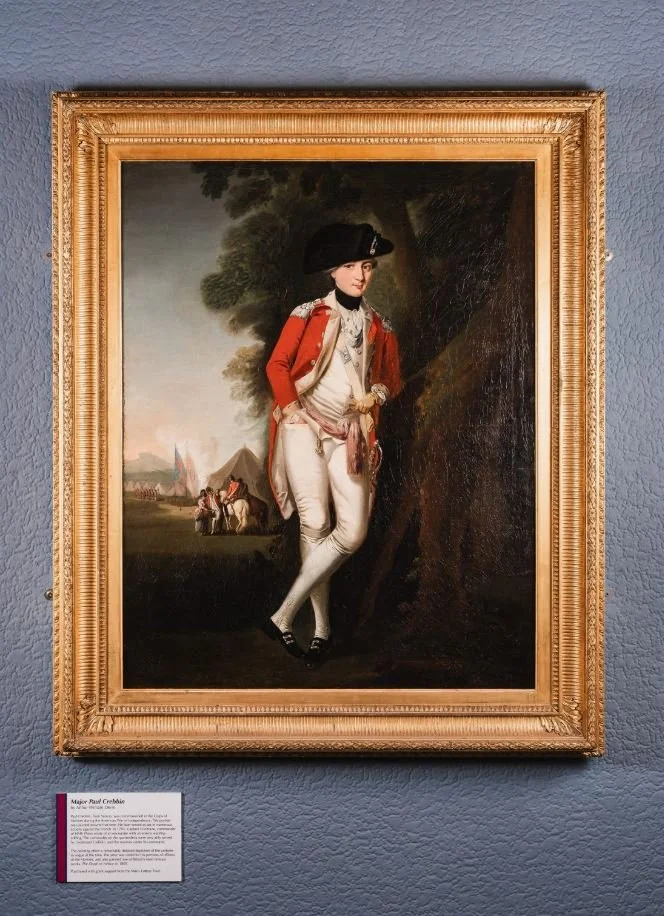
Arthur William Devis, Major Paul Crebbin, 18th Century Oil on Canvas. Image from Manx National Heritage.
The portrait of Major Paul Crebbin is easy to read as a military image: a young officer in a red greatcoat, set against a camp scene, poised at the start of a career that would carry him through some of the defining conflicts of the late eighteenth and early nineteenth centuries. Painted around 1780 by Arthur William Devis, it marks Crebbin’s entry into the marine corps, later the Royal Marines, at just seventeen years old.
Yet the painting rewards slower looking. The confidence of the uniform sits in tension with the youth of the sitter. Crebbin’s expression is composed but not hardened by experience. Knowing his later history, service in the American War of Independence and the Napoleonic Wars, followed by his death at sea in 1819 while returning home, gives the portrait a quiet poignancy. It captures a moment before the weight of those events had taken hold.
The painting also carries a strong Manx identity. Crebbin was born in Santon, the son of a clergyman, and his career reflects a wider Manx relationship with the sea. This was a period of transition, when naval service was increasingly seen as a chosen path rather than an imposed one. Through this single image, the painting speaks to broader patterns of mobility, ambition, and risk that shaped the Isle of Man in the late eighteenth century.
What makes the portrait especially rare is its survival. Many such works were lost, damaged, or dispersed over time. This one remained with Crebbin’s family for more than two hundred years, accompanied by his own letters, which provide a rare written voice to sit alongside the painted image. Together, they allow us to see Crebbin not only as a figure in uniform, but as a person living through an uncertain and rapidly changing world.
I was involved in the conservation of the painting prior to its new-found position on display. Often, conservation work ends quietly once a painting leaves the studio, and we do not always see where objects go next or how they are received. For that reason, seeing the portrait reappear over the past month in museum displays, press releases, and news articles has been genuinely moving. Each article added another layer of context: family history, naval records, personal letters, and Manx social history that were not always visible from the studio alone.
Reading these accounts transformed my understanding of the painting. What had begun as careful, focused work with an object expanded into a much larger story about place, identity, and memory. It was striking to watch a painting move from a conserved artwork into a shared public narrative, where historians, curators, and audiences could engage with it from new angles.
Now on display at the Manx Museum, and soon to take its place in the Mann at War Gallery, the portrait of Major Paul Crebbin no longer belongs to a single family or discipline. It belongs to the Island’s history. For me, seeing that transition unfold has been a rare reminder that conservation sits quietly behind the scenes, but its outcomes can resonate far beyond the studio, sometimes in ways we do not expect, and only get to witness much later.
For articles on this paintings see:
https://www.bbc.co.uk/news/articles/c9q12n7zlv5o
https://manxnationalheritage.im/news/rare-18th-century-royal-marines-portrait-enters-manx-national-art-collection/
https://www.iomtoday.co.im/news/entertainment/extremely-rare-portrait-of-royal-marine-acquired-for-national-collection-850405