BEVA 371 Akron: A New Era for Canvas Lining Adhesives
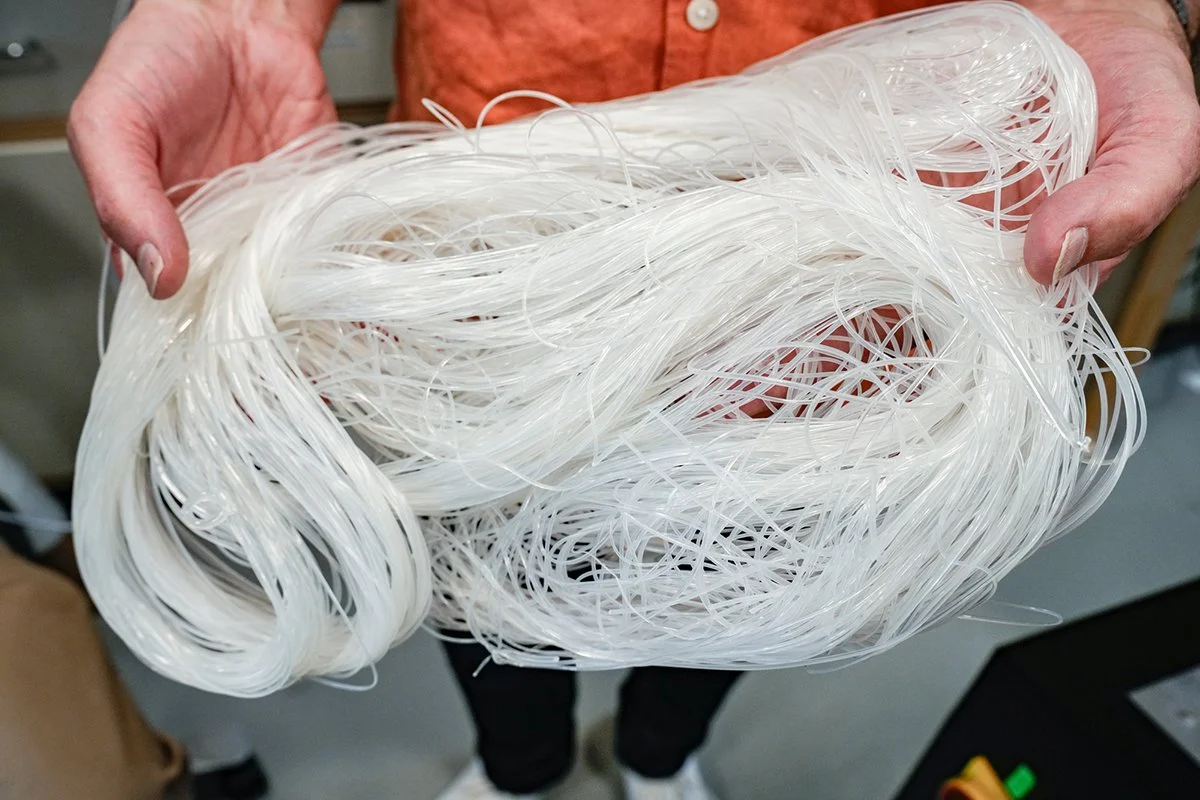
The new solvent-free, spaghetti-like version of BEVA 371 Akron before it is trimmed into pellets and packaged for distribution. Photo by Nita L. Roberts.
For decades, art conservators relied on a special adhesive called BEVA 371 to preserve and reinforce aging canvas paintings. Developed by the innovative conservator Gustav Berger in the 1970s, BEVA 371 quickly gained fame for "sticking to anything" without harming the artwork. However, due to discontinued ingredients and evolving safety standards, the original formula became unavailable, leaving a critical gap in conservators’ toolkits. Now, thanks to a collaborative research effort led by the Getty Foundation, New York University (NYU), and The University of Akron, a new formulation called BEVA 371 Akron has emerged as a safer, sustainable, and equally effective successor to Berger’s original adhesive
The Legacy of BEVA 371 in Art Conservation
Gustav Berger’s BEVA 371 (Berger’s Ethylene Vinyl Acetate) was introduced in 1972 as an advanced adhesive for lining paintings on canvas – a restoration technique where a new canvas is attached to the back of a weakened or damaged painting for support. At the time, many conservators used wax-resin adhesives that often seeped through and darkened the paint. Berger, drawing on his engineering background, formulated BEVA 371 to overcome these issues by remaining tacky at moderate heat without turning fully liquid. This meant conservators could activate BEVA 371 at around 65 °C so it adhered firmly to the canvas without penetrating the fibers (a “heat-set” application), yet if heated slightly more (around 70 °C) it would flow as a hot-melt for a stronger bond. The result was an adhesive with a long working time (“long window of viscosity”) and minimal risk to the artwork’s surface.
BEVA 371’s advantages were quickly recognized: it formed strong bonds but did not stain or darken the paint layers. It was famously first used on Marc Chagall’s Paris Through a Window during a 1970s conservation treatment, and subsequently thousands of paintings worldwide have been lined with BEVA 371. Part of its success lies in the chemistry of its base polymer, ethylene vinyl acetate (EVA). EVA is a copolymer that combines two different types of polymer strands – one that interacts well with waxes and low-surface-energy materials, and another that provides flexibility and adhesion to polar surfaces. This unique makeup gave BEVA 371 an uncanny ability to adhere to both brittle canvas fibers and even wax-saturated surfaces from previous restorations (hence the observation that “it could stick to anything”). In short, Berger’s invention became a mainstay of painting conservation due to its strength, versatility, and gentleness on original materials.
A Sticky Problem: Why Reformulation Was Needed
Despite its remarkable track record, the original BEVA 371 formula faced an unexpected obsolescence. Two key ingredients were phased out by manufacturers: Laropal K-80, a resin critical to BEVA’s desirable working properties, was discontinued in 2005, and Cellolyn 21E, a phthalate-based tackifier, went off the market in 2020. These components had helped BEVA 371 achieve its low-temperature tack and stable consistency. When they became unavailable, the BEVA adhesive supplied after 2008 (using substitute ingredients) just wasn’t the same. Conservators noticed that the newer formulation had to be heated to a higher temperature (~70 °C) to activate and went straight from solid to liquid without the earlier gradual “sticky-solid” phase. In practical terms, it behaved only as a traditional hot-melt glue and lost the gentle heat-set capability of Berger’s original. This abrupt tack development made it more challenging to use: the adhesive could no longer be applied as a soft, repositionable layer at 65 °C, thus increasing the risk of misalignment or even heat damage to heat-sensitive artworks.
The loss of BEVA 371’s optimal properties was a serious concern for painting conservators worldwide. As Dr. Ali Dhinojwala of University of Akron noted, “without these key resins, a major resource for the field of art conservation was lost”. The need for a modern substitute that could match the original adhesive’s performance – particularly its favorable thermal behavior – became pressing. Conservators were seeking an adhesive that could once again function in both modes (heat-set and hot-melt) at safe temperatures, ensuring secure adhesion without compromising the artwork.
Modernizing BEVA: A Collaborative Solution
Recognizing the urgency, the Getty Foundation launched a project under its Conserving Canvas initiative to reformulate BEVA 371. In 2021, Getty awarded a research grant to NYU’s Institute of Fine Arts Conservation Center, partnering with polymer scientists at The University of Akron (UA) – home to one of the world’s top polymer science programs. This interdisciplinary team of conservators and chemists set out to create an adhesive that could “perform the way the original did, either as a heat-set or a hot-melt,” effectively recreating Berger’s magic with contemporary, safe ingredients.
Leading the polymer research was Dr. Dhinojwala’s lab at UA, which brought advanced analytical techniques and polymer engineering expertise to the table. The team first studied the molecular architecture of EVA-based adhesives to understand what gave BEVA 371 its unique qualities. Armed with this knowledge, they explored modern resin alternatives for the discontinued components, seeking a new tackifier that avoided phthalates and resins that could mimic the role of Laropal. After multiple formulations and rounds of testing (including sophisticated adhesion tests and even 3D imaging of stress in lined paintings), they arrived at a breakthrough recipe. The result of this multi-year collaboration is the newly reformulated BEVA 371 Akron, named in honor of the University of Akron’s contributions.
BEVA 371 Akron successfully matches the beloved properties of the original BEVA 371, while using only ingredients that are currently available and more environmentally friendly. According to project director Chris McGlinchey of NYU, the team’s deeper understanding of the polymer system allowed them to “tailor properties specifically for the conservation community” and ensure the new adhesive behaves just like Berger’s formula in practice. Notably, the Akron formulation restores the all-important thermal profile: conservators can once again activate it around 65 °C to get that gentle tack for positioning, or heat it further (~70 °C and above) for a full bond – just as they did with the original. In short, BEVA 371 Akron brings back the dual functionality of heat-set versus hot-melt use.
Equally important, the new formula is phthalate-free, eliminating the health and safety concerns associated with the old tackifier. By leveraging newer components (some of which didn’t even exist in Berger’s time), the team was able to avoid hazardous plasticizers while achieving the same stickiness and flexibility. The researchers also meticulously characterized the chemistry of BEVA 371 Akron to anticipate future supply-chain issues, ensuring that the adhesive’s composition is well documented for the next generation of manufacturers. This collaboration showcased how polymer science and art conservation can innovate together – bridging the gap between chemical engineering and cultural heritage preservation.
New and Improved: Features of BEVA 371 Akron
The reinvented BEVA 371 Akron not only mirrors the original adhesive’s performance, but also introduces new formats that make it even more versatile and sustainable. Traditionally, BEVA 371 was sold as a ready-made solution in solvent. The Akron team and its industry partners have expanded this to three versions of the adhesive to suit different needs
Premixed Solution: A ready-to-use adhesive much like the original BEVA 371. Conservators can apply it straight from the container, getting the same familiar working properties (heat-activated tack and strong bond) they expect.
Solid Pellets: A new solvent-free form of BEVA 371 Akron is manufactured by extruding the adhesive into long, flexible “noodles” which are then cooled and chopped into small pellets. These pellets have a much longer shelf life and significantly lower shipping weight (since no heavy solvents are included). Conservators simply take the needed number of pellets and dissolve them in a solvent of choice in their studio, creating just the amount of adhesive required for a project. This mix-on-demand approach reduces waste and allows using newer, less toxic solvents as they become available
Non-woven Film: The team is also developing a fibrous, non-woven version of BEVA 371 Akron. This form looks like a thin web or sheet of pure adhesive. Because it is made of interlaid adhesive fibers without any fabric backing, it can conform closely to irregular or textured surfaces. Such a web adhesive can be activated with gentle heat between layers, making it easier to achieve good contact on an uneven painting surface. And like the pellets, it’s produced without solvents, aligning with the goal of more sustainable conservation materials
All three forms are chemically the same core adhesive, so conservators can choose the format that best fits their workflow. The introduction of solvent-free options is a big step toward greener practices – reducing harmful fumes in studios and cutting down on shipping emissions (no more sending heavy, flammable solvent-filled cans around the world). “The new forms and sustainable attributes of BEVA 371 Akron are a major win for our field,” says Matteo Rossi Doria, a conservator who helped test the new formula, noting that these choices will help conservators “lower their environmental impact as they can mix solvents on demand”
Future Impact
The development of BEVA 371 Akron underscores what can be achieved through partnership across disciplines and continents. The project brought together veteran paintings conservators and polymer scientists, merging practical conservation experience with cutting-edge materials research. According to those involved, this synergy was key to reviving a material that many had feared lost. “It’s a big win anytime you enable a conservator to do their work more safely and effectively,” Chris McGlinchey observes, highlighting the improved safety profile of the new adhesive
Importantly, the BEVA 371 Akron project was not conducted in isolation. From the outset, the team engaged the global conservation community to vet and refine the adhesive. Experienced conservators like Matteo Rossi Doria in Rome put the experimental formulations through real-world trials to ensure they met professional standards. Their feedback helped fine-tune the recipe and confirmed that BEVA 371 Akron truly “matches the original formula’s characteristics” in practice. The response has been enthusiastic – after all, conservators are regaining a trusted tool, now updated for the 21st century.
Distribution of BEVA 371 Akron is already in progress. The premixed version is being produced by established conservation suppliers (Conservator’s Products Company in the U.S. and CTS in Italy). This means conservators around the world will soon be able to obtain the adhesive in whichever form suits their needs, ensuring that paintings lined with BEVA 371 Akron can continue to hang safely in museums and galleries for years to come.
Beyond the laboratory and the factory, the BEVA 371 Akron initiative had a strong educational component. Getty’s Conserving Canvas program sponsored workshops and webinars that brought together senior conservators and emerging professionals to share lining techniques and introduce the new adhesive. Graduate students from NYU’s Conservation Center and early-career conservators from across Europe got hands-on experience working with both the original BEVA 371 (from remaining stock) and the reformulated Akron version. These sessions were crucial not only for testing the adhesive in practical scenarios, but also for passing down expert knowledge in structural canvas treatments. As Getty Foundation program officer Lorinda Wong noted, supporting training to keep the field strong and adaptable is a core goal – over “250 conservation professionals across the globe” participated in Conserving Canvas workshops, ensuring they have the latest research and resources to do their crucial work
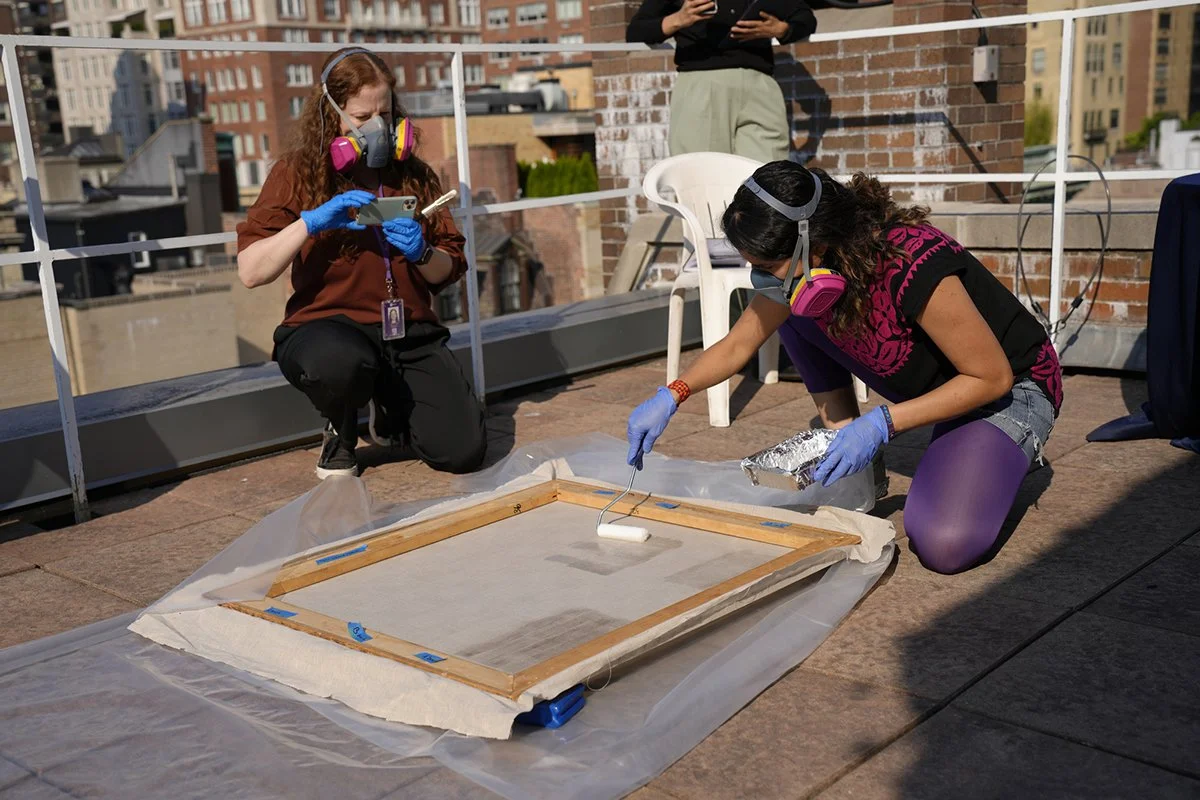
Graduate students at the Conservation Center of NYU’s Institute of Fine Arts test out the new BEVA 371 Akron formulation on the building’s rooftop in Manhattan. Photo by Nita L. Roberts.
Long-time experts in the field have hailed the project’s outcomes. “Out of all the great things that Getty has done with Conserving Canvas, this project is arguably the most important,” says Paul Ackroyd, a conservator at The National Gallery, London. With its advances in material innovation and sustainability, BEVA 371 Akron is being celebrated as a shining example of successful collaboration in a niche yet vital area of art conservation. It demonstrates that even a specialized problem (like replacing a beloved adhesive) can be solved when the right partners come together with support from institutions like Getty.
Conclusion
The story of BEVA 371 Akron is a testament to innovation driven by necessity. An adhesive once thought irreplaceable, then nearly lost to time, has been re-engineered through collaboration between conservators and polymer scientists. BEVA 371 Akron carries forward Gustav Berger’s legacy by retaining the defining strengths of the original material while responding to contemporary concerns around health, safety, sustainability, and supply stability.
At the same time, this optimism needs to be tempered by professional caution. BEVA 371 Akron remains a novel material, and like all new formulations in conservation, its long-term behaviour can only be understood through continued use, testing, and critical reflection in practice. Performance under studio conditions, ageing behaviour, and interaction with a wide range of historic and modern materials will only become clear over time. This uncertainty is not a flaw, but a reminder that conservation materials are never static solutions.
As such, BEVA 371 Akron should be approached not as a definitive replacement, but as an evolving tool whose role will be shaped by evidence and experience. I look forward to one day testing this material directly against earlier BEVA formulations within my own practice, contributing in a small way to the ongoing evaluation that underpins responsible structural treatment.