David Hockney, The Man Who Painted the Sun From a Rainy Street in Bradford, Dies 88.
David Hockney died on 11 June 2026. He was 88. He was also, depending on who you ask, a Bradford kid who never quite left, a California dreamer who never quite arrived, a queer man who painted love before it was legal, a chain-smoker who outlived the debate about chain-smoking, and a technologist who made the fax machine briefly feel like a miracle.
He was all of these at once. That was, as it turns out, the whole point.
The Pools
There's something almost absurd about the swimming pools.
A boy from industrial West Yorkshire, all fog and terraced houses and the faint permanent smell of wool mills on the wind, grows up and becomes famous for painting water that catches the light in ways you didn't know water could. The pools aren't just pretty. They're wrong, in the way that all great art is a little wrong. Too blue. Too still. Too perfectly, unnervingly turquoise. The kind of blue that doesn't exist in nature so much as in memory, in longing, in the idea of a place you've been dreaming about since before you'd been there.
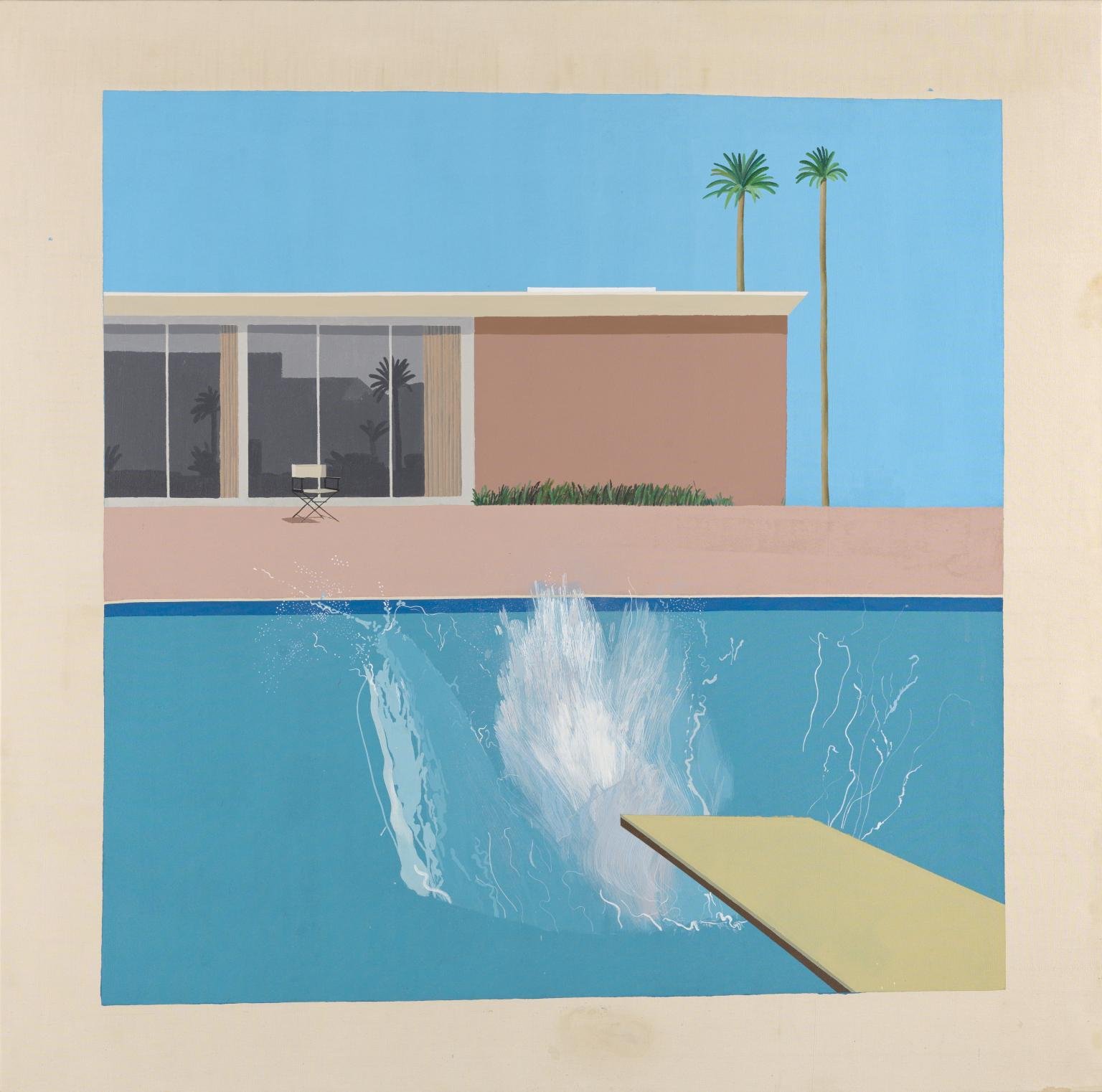
David Hockney, A Bigger Splash, 1976. The painting that made the world stop and look at water differently. That frozen arc of white is already gone by the time you see it.
You look at A Bigger Splash, that frozen arc of white water hanging in the air above the flat plane of the pool, the empty diving board, the low Los Angeles architecture baking in the distance, and you feel something that takes a moment to name. It's not just beauty. It's the sensation of having just missed something. Of arriving one moment too late to a scene that was electric seconds ago. The splash is mid-air. The person is already gone beneath the surface. The sun doesn't care. The house just sits there, clean-lined and indifferent, as if this kind of loss happens every afternoon.
Which, in LA, it does.
Hockney painted that picture in 1967. He was thirty. He had moved to Los Angeles a couple of years earlier, seduced, like so many before him, by the light, the looseness, the sense that the old world's rules didn't quite apply out here. He'd seen a photograph of a swimming pool in a magazine and felt something shift. The Bradford boy with the bleach-blond hair and the round spectacles and the cigarette had found his subject.
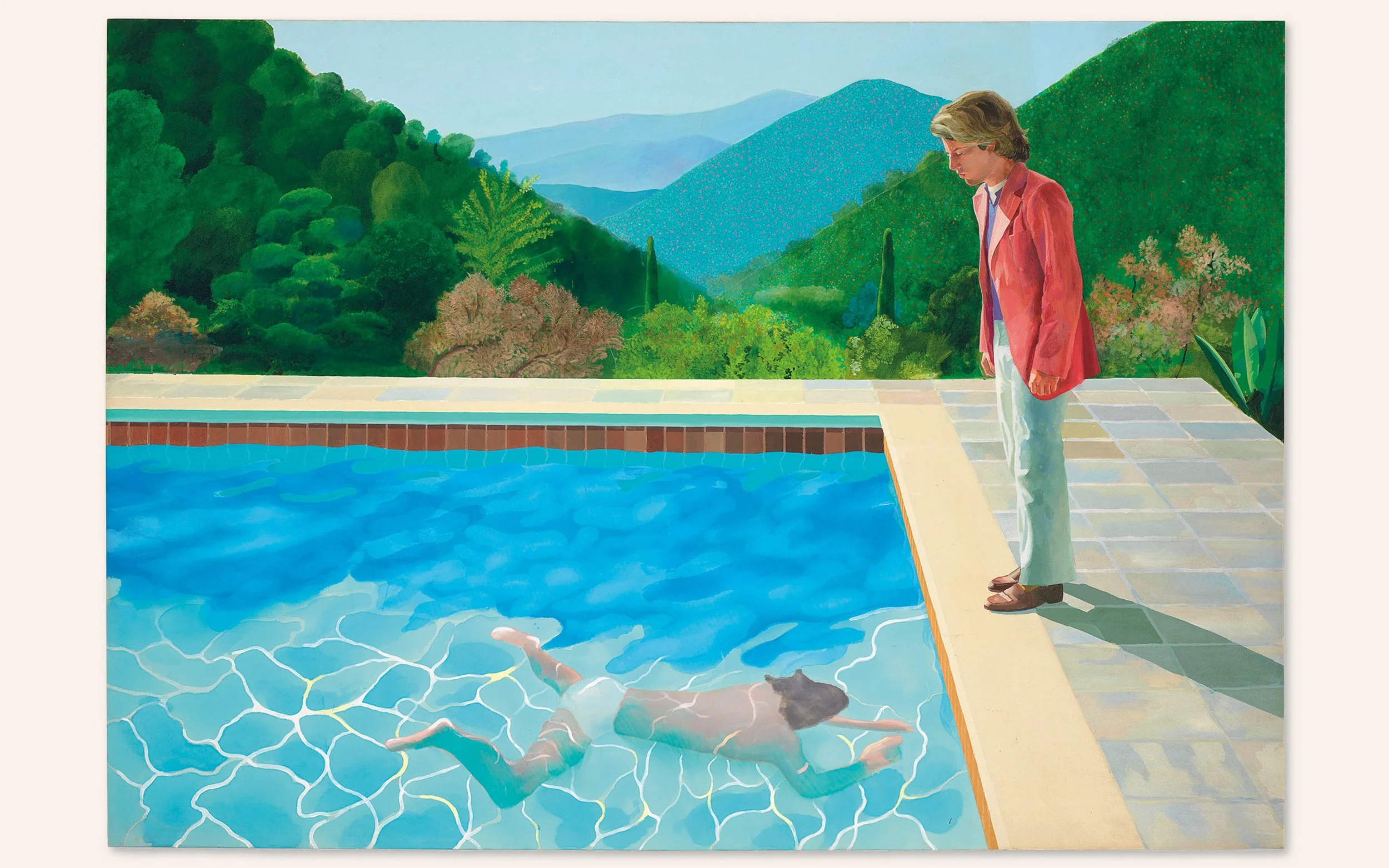
David Hockney, Portrait of an Artist (Pool with Two Figures), 1972. The painting that sold for $90.3 million in 2018. Love and loss, rendered in California light.
But here's the thing about the pools: they're not really about California. Or rather, they're about California the way great immigrant art is always about somewhere else. They're painted with the eyes of a man who grew up somewhere the sun was a rumour. Somewhere grey and real and grinding and full of character, where nobody had a pool, where the idea of standing outside in your swimming trunks in November was genuinely funny. The blue is so intense because he came from somewhere it wasn't. The light is so sharp because he learned to see in the absence of it.
That tension, between where you're from and where you've chosen to be, between desire and its aftermath, between the splash and the stillness that follows, runs like a current through everything Hockney ever made. He didn't leave Yorkshire. He carried it with him into every sun-drenched canvas like a stone in his pocket, like a secret that gave everything else its weight.
The Boy Who Submitted the Wrong Painting
Before the pools, before California, before the bleach-blond hair became an icon, there was a young man at the Royal College of Art in London who was quietly, methodically refusing to do what he was told.
Hockney enrolled at the RCA in 1959. He had already sold his first painting, a portrait of his father, for £10 at the Yorkshire Artists Exhibition two years earlier. He had served his national service as a hospital orderly, having declared himself a conscientious objector. He had arrived in London from Bradford with talent, ambition, and a very specific kind of northern stubbornness that would serve him well for the next sixty years.
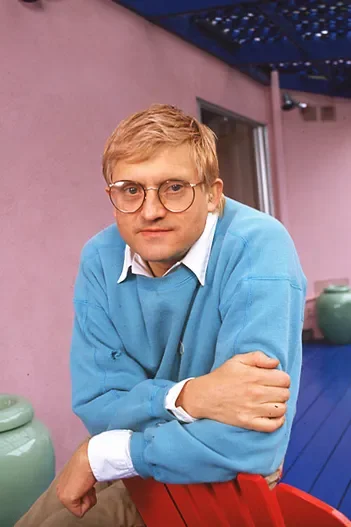
David Hockney at his home in Los Angeles, 1987.Photo: Anthony Barboza/Getty Images
At the RCA, he was supposed to paint a life drawing of a female model. He declined. Instead he submitted Life Drawing for a Diploma, which depicted a muscular male figure sourced from an American physique magazine, the kind of publication that existed in a coded grey area of mid-century gay culture, technically about bodybuilding, actually about something else entirely, understood by those who needed to understand it.
The statement wasn't subtle. In 1961, in Britain, homosexuality was still a criminal offence. You could go to prison for it. And here was this Bradford kid, twenty-four years old, submitting a drawing of a male body in a state of near-undress to his final examination and daring the institution to fail him for it.
They didn't. The RCA, aware of the talent it was dealing with, bent its rules. Hockney graduated. He had learned something important: that institutions will often accommodate genius if you force the question. That rules, presented with sufficient confidence and sufficient quality, can be renegotiated.
He spent the rest of his career testing that hypothesis.
Before It Was Legal
The year was 1961. The painting was called We Two Boys Together Clinging, named after a Walt Whitman poem. It showed two figures, rough-hewn and tender, unmistakably in love. It wasn't subtle. It wasn't coded. It was a young man from Bradford saying, in oil paint on canvas, in a country where what he was describing was a crime: this exists, this is real, this is worth painting.
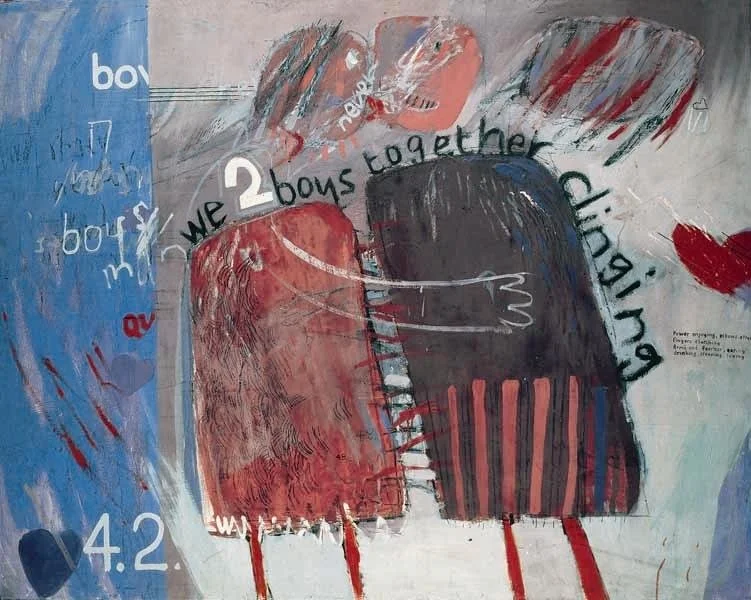
David Hockney, We Two Boys Together Clinging, 1961.
Think about what that took.
Not bravery in the abstract, philosophical sense. Bravery in the specific, material, this-could-ruin-your-life sense. The Wolfenden Report had recommended decriminalising homosexuality in 1957, but Parliament wouldn't act on it for another decade. In the meantime, men were still being prosecuted. Careers were still being ended. Lives were still being quietly, efficiently destroyed by a legal system that had decided a particular kind of love was a public danger.
And into this atmosphere, Hockney kept painting. Cleaning Teeth, Early Evening (10pm) W11 in 1962, with its phallic Colgate tubes and its chains. The swimming pools in Los Angeles, where men lay around each other in the sun with an ease that England hadn't yet figured out how to permit. The portraits of his lovers, tender, intimate, unashamed.
He never made a speech about it. He didn't write manifestos. He just painted what he saw and what he wanted, and he kept doing it, and eventually the world caught up.
Tracey Emin, on learning of his death, said he was "a proud chain-smoking homosexual, who flew the flag higher than any other British artist." That's exactly right, and what makes it remarkable is that he flew it not through activism but through the persistent, stubborn, decades-long act of making art about his actual life. He made queerness visible at a time when visibility was itself a form of courage.
He never seemed to think he was being particularly brave. That, perhaps, was the bravest thing of all.
The Joiners, or: What Happens When You Accidentally Invent a New Way of Seeing
Somewhere in Los Angeles in the early 1980s, Hockney was taking reference photographs for a painting with a Polaroid camera. He laid them out. He looked at them. And he noticed something.
A single photograph, he had long felt, lied. It pretended to show you what the eye sees, but the eye doesn't work like that. The eye moves. It dwells. It comes back. It looks at your face and then at your hands and then at the corner of your mouth and then at your eyes again. It builds a picture over time from multiple perspectives, assembling a composite portrait that no single frozen moment can contain. A photograph collapses all of that into one flat plane and calls it reality.
But what if you didn't collapse it? What if you let the multiplicity stand?
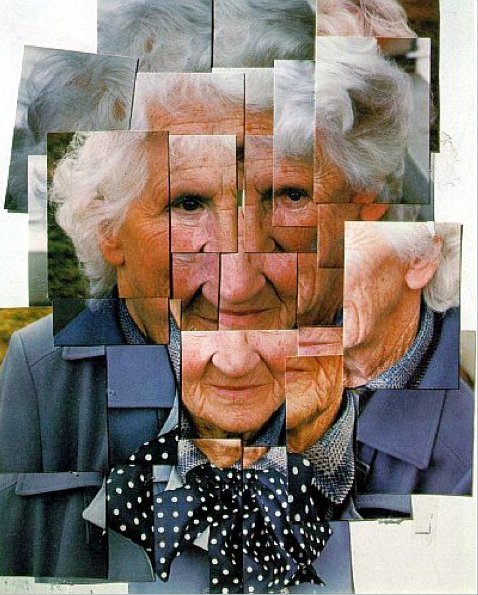
David Hockney, Portrait of the Artist’s Mother, 1985. Not one photograph but dozens, assembled into something truer than any single image could be.
He started assembling multiple photographs together, dozens, sometimes hundreds of images arranged in overlapping grids that circled their subject from every angle. He called them "joiners." They were cubist in spirit, Picasso's influence, which Hockney had absorbed deeply, made visible, but they were made from photographs, from the technology of mechanical reproduction, from the same medium that he felt had been lying about vision for a century.
The joiners changed things. A portrait of his mother built from dozens of overlapping Polaroids captured her more truthfully than any single image could, the way you actually know someone, from years of accumulated glances, from seeing them from every angle over time. A landscape assembled from multiple photographs conveyed the experience of being in a place rather than merely looking at a postcard of it.
It was a solution to a problem that most people hadn't noticed was a problem. That was very Hockney: identifying, with complete seriousness and zero fuss, that something everyone accepted as normal was in fact slightly wrong, and then quietly doing something about it.
The iPad Paintings
He took to the iPad the way some people take to a religion.
From around 2009 onwards, Hockney began making paintings on his iPhone and then his iPad, landscapes, flowers, portraits, studies of light, and sending them to friends by email in the early hours of the morning, excited as a child who has discovered a new game. There was no commercial calculation in this. He wasn't trying to stay relevant or prove a point about technology. He was genuinely delighted. Here was a device that fit in his pocket, that let him draw anywhere, in any light, without the logistics of canvas and oil and studio, and the pictures it made were immediate, bright, direct, alive.
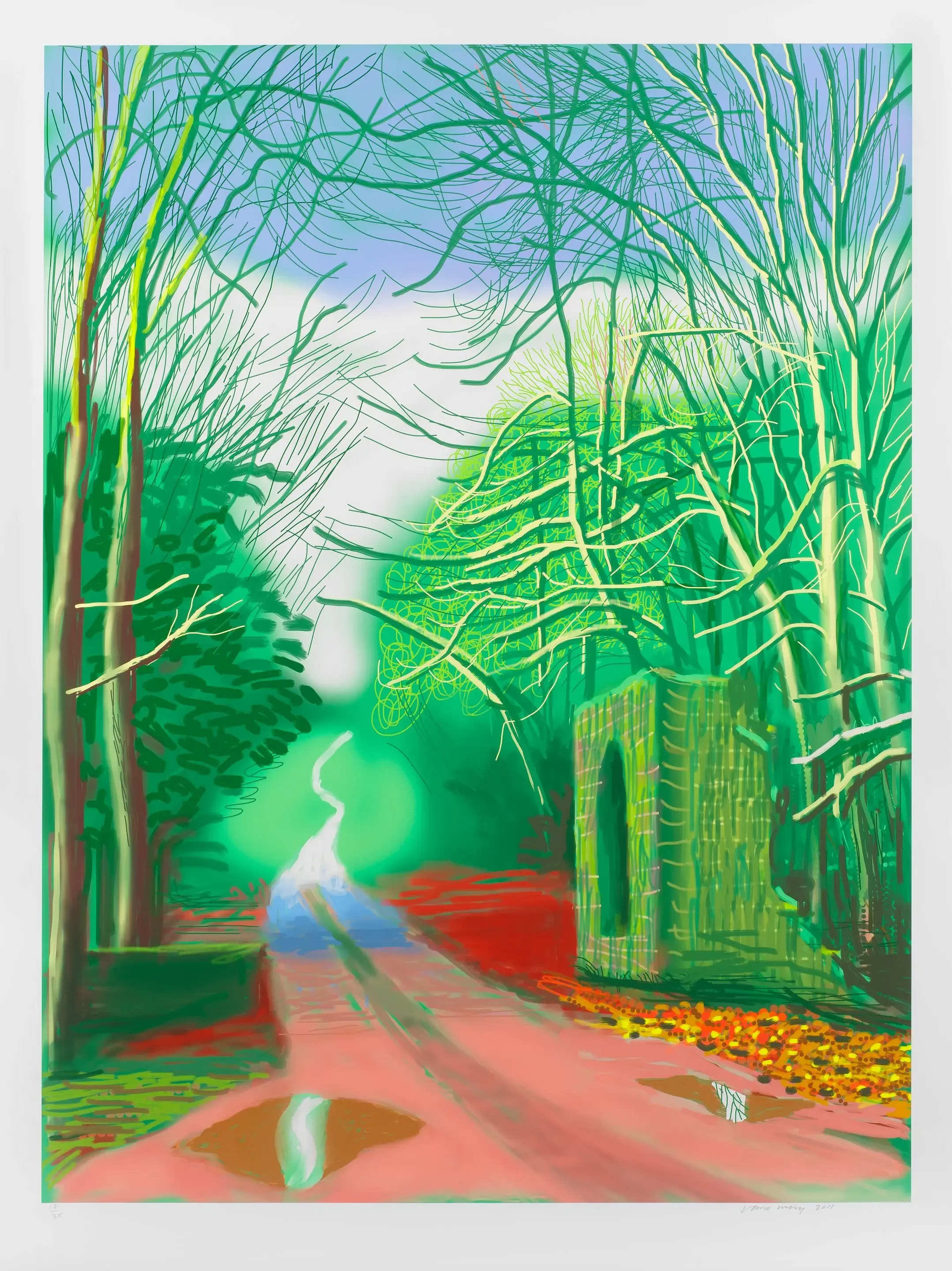
David Hockney, The Arrival of Spring in Woldgate, East Yorkshire in 2011 (twenty eleven).
He produced hundreds of them. Then thousands. He had them printed large, billboard scale sometimes, because he wanted to see what they looked like at that size, whether the intimacy of the small screen survived the expansion. It did. It more than did.
This is the thing that's easy to miss about Hockney's relationship with technology: he was never interested in it for its own sake. No fetishisation of novelty, no technologist's smugness, no sense that the medium was the message. He'd worked with photocopiers and fax machines before the iPad, and would happily have moved on to whatever came next. "I'm really only interested in technology that is about pictures," he said in 2013. "I'm interested in anything that makes a picture."
That's it. That's the complete philosophy. Sixty years of formal innovation, from Polaroid joiners to iPad paintings to experiments with 3D, reduced to two sentences. He was a man with a question, what is a picture, and how many ways can it be made?, and he spent his whole life finding different answers.
The Yellow Crocs
King Charles III, paying tribute after Hockney's death, mentioned the yellow Crocs.
Hockney had apparently worn them to Palace occasions. Charles wrote, with visible affection, that he hoped they would "see him tread safely into the hereafter." It's a small detail, but it's the right detail, the one that tells you everything you need to know about who this man was when the cameras weren't necessarily pointing at him.
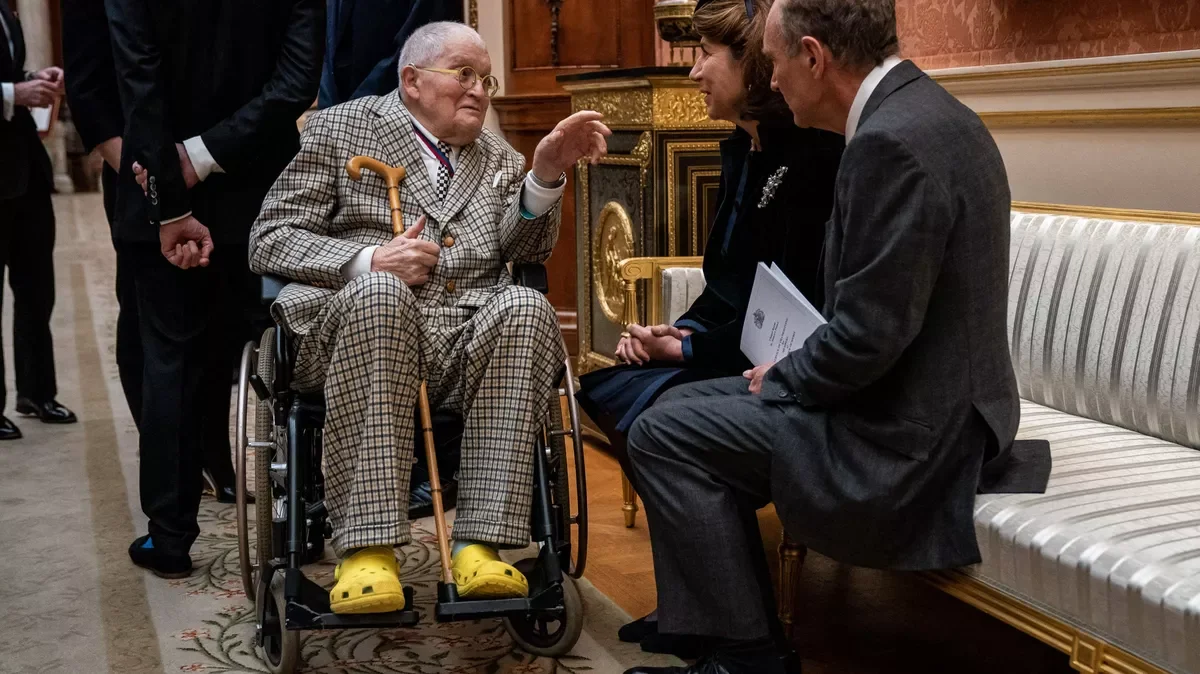
Mr David Hockney during a luncheon for Members of the Order of Merit at Buckingham Palace, London (Source: Reuters)
Think about what it takes to wear yellow rubber shoes to a Palace. Not as a statement. Not as a provocation. Just because you like them and you've decided, at some point in your eighties, that life is too short to wear uncomfortable shoes to places where you'd rather be in the studio anyway. Think about the accumulated weight of not caring what people think, the decades of painting gay life in an era when it was illegal, of refusing knighthoods and royal portrait commissions, of submitting the wrong painting for your diploma and betting that your talent would cover the shortfall.
He declined a knighthood, reportedly on multiple occasions. He turned down an invitation to paint a portrait of the Queen. He wrote a piece for the Guardian calling the smoking ban "the most grotesque piece of social engineering" and meant every word of it. He was argumentative and opinionated and absolutely certain that he was right about certain things, about the history of optics in Old Master painting, which he laid out in his 2001 book Secret Knowledge to the fury of several art historians, about the importance of drawing, about the inadequacy of the single photographic frame.
He wasn't always right. But he was always interesting, and he was always himself, and in a world that puts enormous pressure on artists, especially successful artists, artists with reputations to protect, to smooth their edges and say the diplomatic thing, that stubbornness was its own kind of gift.
Now
He had a stroke in 2012. It took his speech for a while. He went back to the studio.
His assistant Dominic Elliott died in 2013 at twenty-three, a death that shook Hockney so badly he said he couldn't draw for a period. He went back to the studio.
He moved from LA back to Yorkshire in 2005, settling in Bridlington on the East Yorkshire coast, and painted the landscape obsessively, the hawthorn hedges in spring, the same lanes in different seasons, the big flat northern light. Then he moved to Normandy, in France, and painted that. Then he was back, and then he was looking at 3D, and then the iPad, and then something else, always something else, always now.
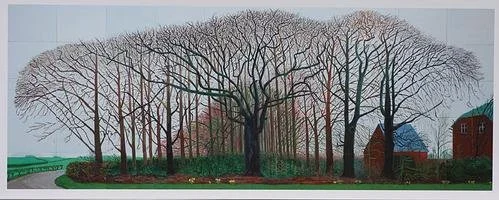
David Hockney, Bigger Trees Near Water, 2007.
"I don't reflect too much," he told the Guardian in 2015. "I live now. It's always now."
He died at home on 11 June 2026, one month short of his eighty-ninth birthday. He is survived by his long-time partner Jean-Pierre Gonçalves de Lima, his great-nephew Richard, his brothers Philip and John, and the paintings, thousands of them, in galleries and museums and private collections and on the screens of the friends he emailed at six in the morning when he'd made something he was excited about.
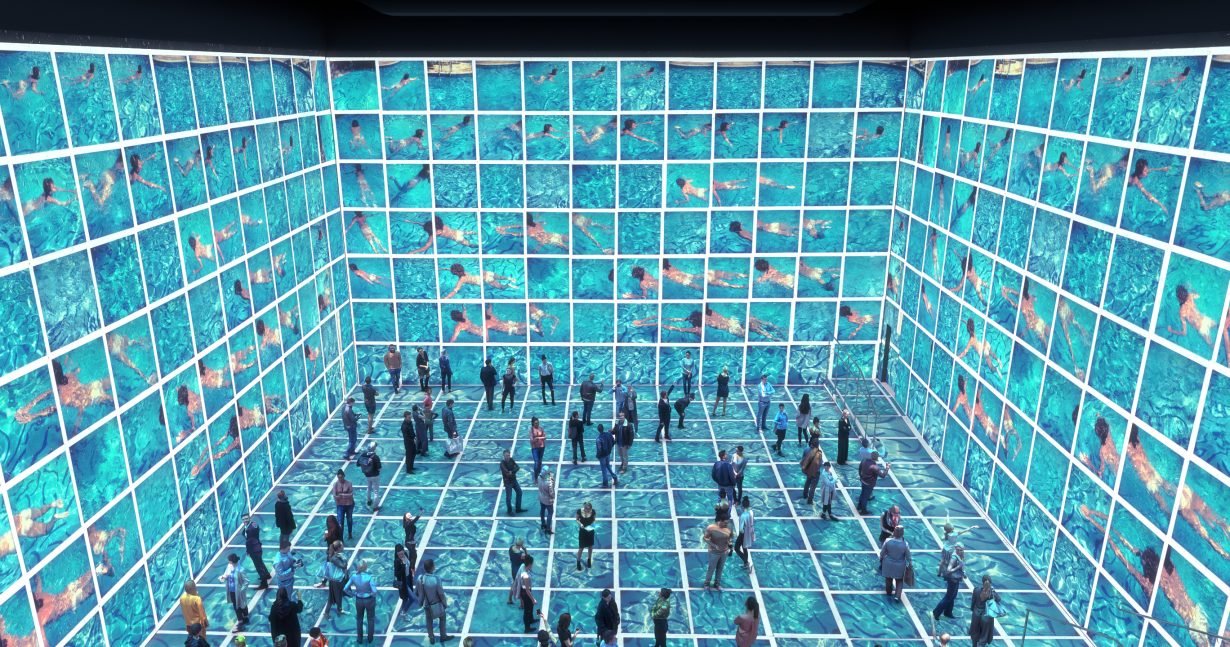
David Hockney, Bigger & Closer (not smaller & further away), 2023 (installation view). Photo: Justin Sutcliffe. Courtesy Lightroom, London
The Tate is planning an exhibition. The Pompidou called his works "dazzling, alive and eternal." Everyone who knew him seems to have a story about his generosity, his humour, his absolute seriousness about looking at the world.
The splash is still in the air. The house bakes in the distance. The water is that impossible, heartbreaking blue.
He made it that colour on purpose. He knew exactly what he was doing.
David Hockney, 9 July 1937 – 11 June 2026.