Behind the Painting: Laughing Fool
He is laughing at you. That much is clear.
What is less clear, and what makes this small, strange, centuries-old painting genuinely difficult to shake, is whether the joke is on you specifically, or on all of us, or on no one in particular. Because the fool in this painting is not performing laughter for your entertainment. He is not the court jester caught mid-tumble, the comic figure of a scene you have wandered into. He is looking directly out of the frame, his face split open in a wide, toothy grin, and he is holding up his hand in front of his face in a gesture that art historians link to a Netherlandish proverb about turning a blind eye. He sees you. He has decided something about you already. And whatever he has decided, he finds it very funny.
This is one of my absolute favourite paintings. It is tiny. It is unsigned. We are not even completely certain who made it. And it is, for my money, one of the most psychologically alive faces in all of Northern Renaissance painting.
The Painting
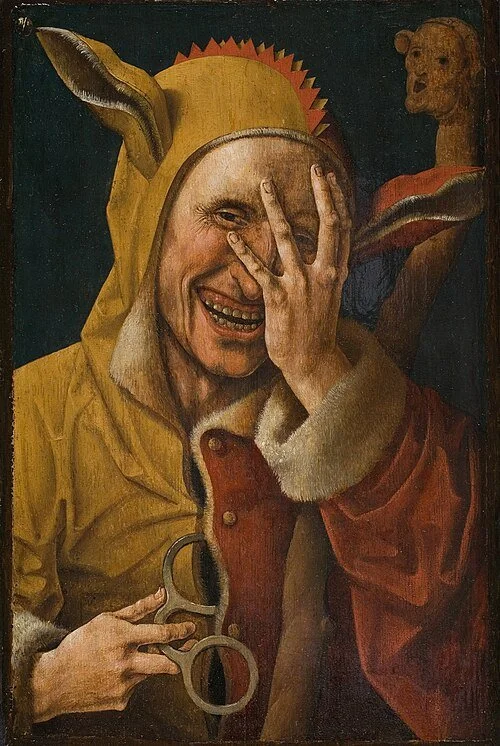
Attributed to Jacob Cornelisz. van Oostsanen. Laughing Fool. c. 1500. Oil on panel. 35.1 × 22.9 cm. Davis Museum at Wellesley College, Massachusetts.
Small enough to hold in two hands. No signature. No inscription. No record of where it came from before it found its way to the Davis Museum. The attribution to Jacob Cornelisz. van Oostsanen is the considered judgement of art historians working from style, technique, and the visual culture of Amsterdam around 1500, but the word "possibly" in the title is not decoration. It is an honest acknowledgement that we are working in the territory of the probable rather than the certain.
That uncertainty feels, somehow, appropriate for a painting about a figure whose entire purpose was to refuse certainty.
The Artist We Think Made It
Jacob Cornelisz. van Oostsanen was born around 1470, probably in Oostzaan, a small town north of Amsterdam. He is widely regarded as the earliest major painter of Amsterdam whose name we actually know, which is its own kind of distinction: the first voice out of a city that would go on to produce Rembrandt and Vermeer, working at a moment when Amsterdam was still a flourishing provincial town rather than the commercial capital it would become.
He trained, most likely, in Haarlem, where he absorbed the detailed, emotionally specific painting tradition of the northern Netherlands. He became a skilled designer of woodcuts as well as a painter, worked extensively for Egmond Abbey, and spent most of his long career in Amsterdam, buying his first house there in 1500, the same year this painting is thought to have been made. He died in 1533, the same year his wife was first recorded in the archives as a widow.
What marks van Oostsanen's work is a combination of sharp technical precision and genuine psychological interest in his subjects. His faces are not idealised. They are observed. They carry the evidence of specific inner lives rather than the generic beauty of Italian Renaissance portraiture. In this he is very much a product of the Northern tradition, where the goal of painting was not elevation but truth, however uncomfortable truth might be.
What You Are Looking At
The fool fills almost the entire picture plane. This is an important choice. There is no context, no setting, no room or landscape or court behind him. Just darkness, and the figure pressing forward out of it, close enough that you feel the intimacy of the encounter whether you want to or not.
He wears the standard costume of the professional fool: a hood fitted with the ears of a donkey, the colour divided between yellow and green. The colour choices were not arbitrary. In medieval and early modern Europe, yellow carried associations with instability and excess. Green signalled disgrace. Together, on the body of the fool, they formed a visual shorthand that any viewer of the time would have read immediately: this person occupies a special category outside ordinary social order.
In his arm he carries a marotte, the carved wooden staff topped with a miniature jester's head that was part of the professional fool's equipment. The marotte's own mouth is open, either laughing or shouting, as if it too has something to say. The fool's hand is raised near his face, not quite covering it, the fingers spread so that his grin is still fully visible through them. This gesture is the key to the whole painting.
Art historian Görel Cavalli-Björkman, who has written about several versions of this image, connects the peeping-through-fingers gesture to a Netherlandish proverb. The Dutch saying roughly translates as: he who does not look through his fingers does not belong in this world. To look through your fingers was to wilfully avoid seeing things as they are, to turn a blind eye, to practise the convenient self-deception that gets you through daily life. The fool is doing it, openly, as a kind of demonstration. And in doing it, he is suggesting that you do it too. Every day. Without the honesty to admit it.
Behind him, barely visible in the darkness, there is what appears to be a faint second figure. Ghostly, unresolved, difficult to make out. Whether this is a deliberate compositional choice or an accident of condition is unclear to me, and I think about it every time I look at the painting. If it is intentional, the presence of that half-seen figure behind the fool, watching from the dark, adds another layer to something that is already several layers deep.
The Fool as Cultural Symbol
To understand why this painting is so dense with meaning, you need to understand what the fool actually was in 1500 Northern Europe. Not the entertainer. Not the clown. Something far more complex and philosophically charged.
The figure of the fool had been developing as a moral and theological symbol for centuries by the time van Oostsanen painted this. Its deepest root is Psalm 52 in the Latin Bible: "Dixit insipiens in corde suo: Non est Deus." The fool hath said in his heart, there is no God. This was the foundational text for the fool's iconography throughout the medieval period. The fool was not simply stupid. The fool was the person who had turned away from wisdom, from God, from the proper ordering of existence. The jester's costume, the donkey ears, the inverted sceptre, all of it was visual shorthand for a category of moral failure.
And yet by 1500 the meaning was shifting and complicating. Sebastian Brant's Ship of Fools, published just six years before this painting was made, had used the fool figure as a mirror held up to all of society, not just the spiritual delinquent of the Psalms. Brant's fool was everyone: the corrupt cleric, the greedy merchant, the vain nobleman, all sailing cheerfully toward destruction. And Erasmus, writing his Praise of Folly in 1511, would take the idea further still, using the fool's licence to say the unsayable in order to expose the absurdity of human pretension at every level of society.
What makes the fool interesting, and what the painting captures, is that this figure occupied two contradictory positions at once. On one hand, he was the symbol of moral blindness and spiritual failure. On the other, he was the only person in the room permitted to tell the truth. Court fools, because they were officially outside the social order, could say things to kings that no one else could say and survive. The donkey ears that marked stupidity also, paradoxically, marked immunity from the rules that silenced everyone else.
The fool in this painting holds both meanings simultaneously. His laughter is both the symptom of folly and the weapon of the truth-teller. That is why the painting feels so unresolved, so alive. It refuses to land on one side.
The Particular Quality of This Laughter
I want to spend some time on the face, because it is doing something very specific that I do not think gets enough attention.
This is not warm laughter. It is not the comfortable laughter of shared amusement. The mouth is too wide, the teeth too prominent, the gaze too direct and too knowing. If you encountered this laugh in a corridor, your first instinct would not be to laugh along. Your first instinct would be to wonder what you had done.
Van Oostsanen, or whoever made this painting, understood that laughter is not a simple or innocent thing. It has a social function as well as an emotional one, and that social function can be welcoming or excluding, generous or aggressive, depending entirely on the direction in which it is aimed. The fool's laughter here is aimed at you. The hand raised near the face, the direct gaze, the marotte's matching open mouth: everything in the composition positions you as the subject of the joke rather than its audience.
This is morally significant. The fool laughing at you, with the peeping-through-fingers gesture of wilful blindness, is accusing you of something. He is the figure who embodies folly, and he is laughing at your folly. There is a mirror in the painting, and it is his face.
A Painting That Knows It Is a Painting
One of the things I find most extraordinary about this work, and most modern-feeling about it, is its awareness of being looked at.
Most Northern Renaissance paintings, however closely observed and psychologically specific, place you as a witness to something that is happening independently of your gaze. The figures in a Nativity scene, a market scene, a portrait, exist within their own pictorial reality. You are looking in.
The fool in this painting is looking out. He knows you are there. He has arranged himself for your benefit, or rather, he has arranged himself to make you as uncomfortable as possible while appearing to perform for you. The raised hand, the grin, the direct engagement: it is a confrontational painting pretending to be an entertaining one. And that pretence, that performance of harmless comedy over something sharper and less comfortable, is exactly what the fool represents.
Erasmus understood this perfectly. The whole structure of the Praise of Folly depends on the idea that only by wearing the costume of the fool can you say things that are genuinely true. The fool's performance is the cover for the truth-teller's operation. This painting knows that. The laughter is the performance. The gaze is the truth.
The Question of Authorship
I want to return briefly to the attribution, because I think it matters to how we encounter the painting.
The "possibly" in the title is not a failure of scholarship. It is the correct and honest response to what the evidence actually tells us. The painting is unsigned. Its provenance before the Davis Museum is unclear. The attribution to van Oostsanen rests on comparison with his other known works, on stylistic consistency with the painting culture of Amsterdam around 1500, and on the informed judgement of specialists who have looked closely at the panel and the paint.
But it could be by someone else. It could be by a very accomplished follower, a studio assistant, an independent contemporary we no longer have a name for. Several near-identical versions of this composition exist in other collections, suggesting that the image circulated, was repeated, was valued enough that multiple hands tried to make it. Who originated it may be beyond our ability to determine.
As a conservator I find this kind of uncertainty genuinely interesting rather than frustrating. The physical object carries evidence that can help answer the question. The way the paint is laid down, the ground preparation, the panel's wood species and construction, the underdrawing if one exists, the condition of specific passages: all of these are legible to the trained eye and the right instruments. Attribution questions are not just archival problems. They are material ones. And this particular painting, given how much is at stake in the "possibly," is exactly the kind of work that rewards close technical examination.
What the uncertainty does not change is the painting's quality. Whatever hand made it, this is a work of genuine intelligence and skill. The face alone is enough to establish that.
Conclusion
I chose this painting because I wanted to write about something that is not frequently discussed with the depth it deserves, and because I think it rewards sustained attention in a way that more famous works sometimes do not.
Laughing Fool is small. It does not announce itself. You could walk past it. But if you stop, if you actually look at it, it will look back at you with an expression that has not softened or simplified in five hundred and twenty-five years. It will still accuse you of the thing the peeping-through-fingers gesture accuses everyone of: the human tendency to avoid seeing clearly, to perform understanding while practising avoidance, to mistake your own comfortable blindness for wisdom.
The fool knows. He has always known. That is why he is laughing.