Behind the Painting: The Nightmare by Henry Fuseli (1781)
There is a reason this painting has never left us.
It was made in 1781 and first shown at the Royal Academy in London in 1782, and from the moment it appeared on the wall, people could not look away. They were horrified by it. They were fascinated by it. The exhibition that year drew over 12,000 more visitors than the year before. Within a year, engraved copies were circulating widely. Within a generation, it had seeped into gothic literature, political satire, and the collective imagination of an entire era. More than two centuries later, it is still one of the most recognisable images in the history of Western painting.
I think about why that is, quite a lot. Because on the surface, it should not work as well as it does. The composition is strange. The figures are odd. The atmosphere is overwrought, almost theatrical. And yet it gets under your skin in a way that very few paintings manage. It knows something about fear, about the body, about the particular vulnerability of sleep, that feels true in a way that is hard to explain.
The Painting
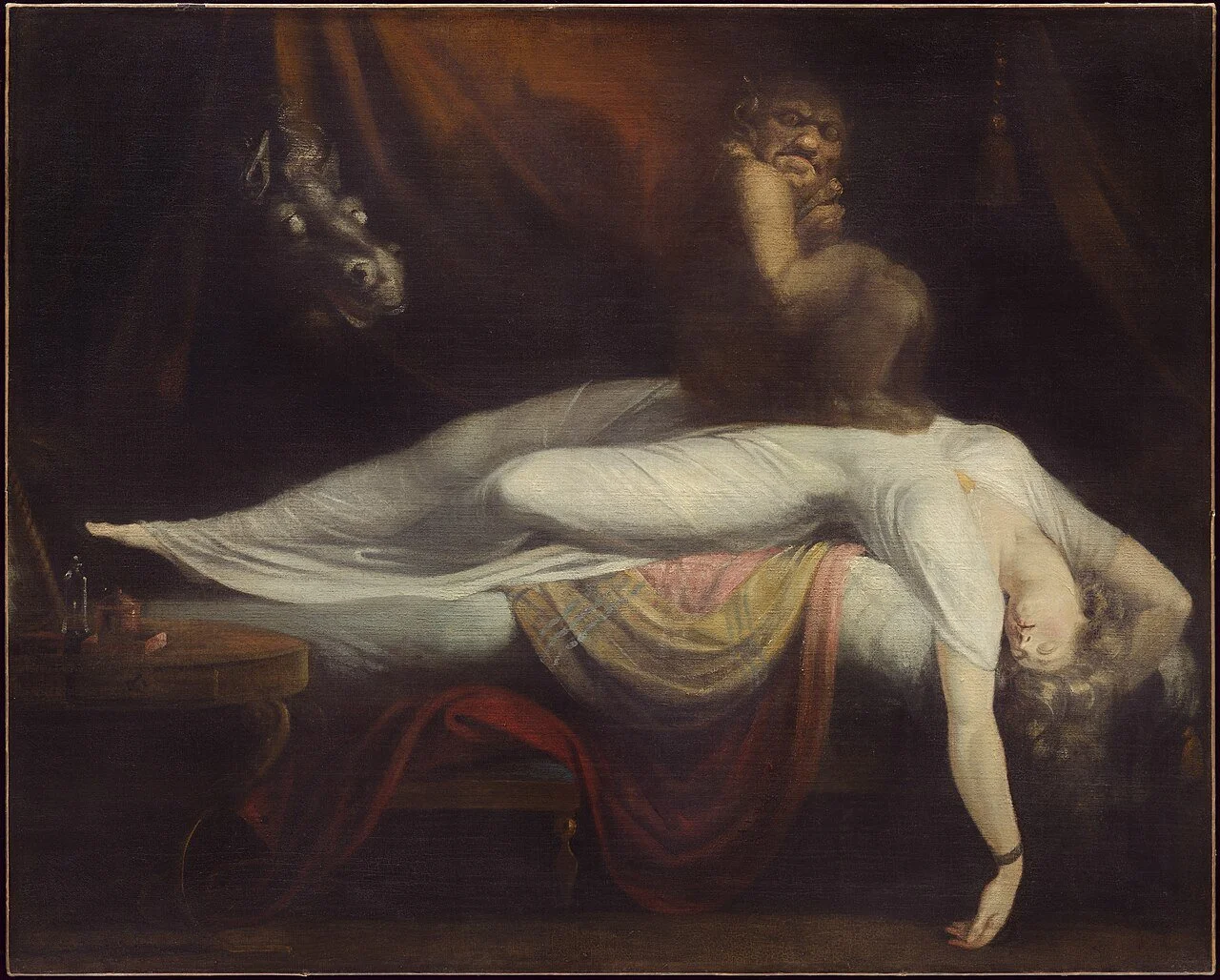
Henry Fuseli. The Nightmare. 1781. Oil on canvas. 101.6 × 127 cm. Detroit Institute of Arts, Detroit.
A woman lies draped across a bed, her body slack, her arms falling away from her sides. She is not arranged in the composed sleep of a portrait subject. She looks abandoned to unconsciousness, her head tipping back over the edge, her white gown gathering around her. Crouched on her chest is a squat, ape-like creature: the incubus, a demon from folklore believed to visit sleeping women. It sits with its full weight pressing down on her, its face turned directly outward to stare at us. And emerging from behind a dark red curtain at the back of the composition, its eyes white and bulging and entirely blank, is the head of a horse.
Three figures. Two of them impossible. One woman, completely at their mercy.
The Artist
Henry Fuseli was born Johann Heinrich Füssli in Zürich in 1741, the second of eighteen children. His father was a portrait painter, his family was deeply educated, and the plan was for Fuseli to become a minister, which he did, briefly, before his life took a different shape entirely. He left Switzerland in his early twenties, eventually arriving in London, then spending eight transformative years in Rome, before returning to England where he would spend the rest of his long career. He died in Putney in 1825, aged eighty-four.
In his lifetime, Fuseli was actually better known as a lecturer and writer on art than as a painter. He was a Professor of Painting at the Royal Academy, then its Keeper. He was considered brilliant, difficult, and eccentric. His work sat in an uncomfortable place between the cool reason of Neoclassicism and the emotional intensity of the Romanticism that was beginning to take hold. He drew on Shakespeare, on Milton, on mythology, on folklore, on the darkest corners of the imagination.
Fuseli once wrote that one of the most unexplored regions of art are dreams. The Nightmare was his attempt to map that territory. Nothing quite like it had been shown at the Royal Academy before, and the critics did not know what to do with it. It did not fit into any established category: it was not history painting, not portraiture, not a scene from literature or the Bible. It was something else entirely. Something that seemed to come from inside the mind rather than the observed world.
It became his first commercially successful work. He would return to the subject at least three more times.
What You Are Actually Looking At
Let me start with the woman, because she is the anchor of the whole thing.
Fuseli has painted her in a state of total physical surrender. There is no tension in her body, no resistance. The hand nearest us hangs completely loose, the fingers soft, the wrist bent back. Her head is tilted so far that her neck seems almost to have given way. The white of her gown catches the light while everything around her dissolves into darkness, which means your eye goes to her immediately and stays there. She is the most illuminated thing in the painting, and she is completely without agency.
This is not an accident. Fuseli was deeply interested in the erotic charge of helplessness, in the particular quality of a body that has surrendered conscious control. The painting has a sensuality to it that would have been unmistakable to viewers in 1782 and remains unmistakable now. The incubus sits on her chest with the ease of ownership. The pose of her body is, as many scholars have noted, not entirely unlike the pose of a pietà: the same loose weight, the same impression of a body given over entirely to something beyond it. Whether that register is devotional or erotic or both is a question the painting deliberately refuses to answer.
Then there is the incubus. It is one of the strangest figures in eighteenth-century painting. It is neither fully animal nor fully human. Its face is ancient and flat and knowing. It does not look at the woman beneath it. It looks at us, with an expression that reads somewhere between challenge and complicity. The word incubus comes from the Latin for to lie upon, and the creature was a figure in folklore understood to visit sleeping women and oppress them, sometimes sexually. Fuseli would have known this etymology well. The choice to place this thing on her chest, looking directly out of the frame, feels like an invitation: he is making us participants in the scene, not merely observers.
And then the horse. The word nightmare, it turns out, has nothing etymologically to do with horses. The mare in nightmare comes from mara, a spirit from Germanic and Scandinavian folklore sent to torment sleepers with terrible dreams, sometimes to suffocate them. Fuseli's painting is where our modern confusion of that word with horses began: his visual pun so thoroughly colonised the imagination that the etymology shifted around it. The horse in the painting looks on with its white, sightless eyes from behind the curtain, a witness or an accomplice. Its blankness is the most unsettling thing about it. It is not horrified. It is not menacing. It is simply watching, as if this is entirely ordinary.
The Personal Underneath
There is a detail about this painting that I find as haunting as anything in the composition itself.
On the back of the canvas, hidden from all but conservators and curators, there is an unfinished portrait. It is believed by many art historians to be Anna Landolt, a young Swiss woman with whom Fuseli fell passionately and apparently obsessively in love while he was in Rome. She was the niece of his close friend Johann Kaspar Lavater. Her family objected to Fuseli. She did not return his feelings. She became engaged to another man.
In the letters Fuseli wrote to Lavater around this time, he was not restrained about what he felt. He wrote about her with a feverish intensity, confiding fantasies that mixed desire with frustration and something darker. By 1781, when he painted The Nightmare, the rejection was complete and behind him. And yet he appears to have turned the canvas over and painted her on the back of it before he began.
Art historian Horst Waldemar Janson proposed in 1962 that the incubus is a self-portrait of Fuseli, that the sleeping woman is Anna Landolt, and that the painting is an act of fantasy, grief, and perhaps revenge all at once. This reading has been debated ever since, and it is worth being clear that it remains a theory rather than a certainty. The portrait on the reverse has never been definitively confirmed as Landolt. But the reading has proved difficult to dislodge, partly because the letters are so revealing, and partly because the painting feels so specific in its emotional charge: this is not a generalised nightmare. It feels like someone's nightmare in particular.
Whether or not you accept the biographical reading, I think it adds something important to how we encounter this work. Because the incubus looking out at us carries a different weight if we consider the possibility that Fuseli is in some sense placing himself there. The look on its face is not just a challenge to the viewer. It might be an act of confession.
The Language of the Painting
Fuseli was trained in the European tradition and understood very well how light and composition work as emotional instruments. The Nightmare uses both with calculated precision.
The single, concentrated light source picks out the woman and leaves almost everything else in near-total darkness. The red curtain at the back is a deep, blood-adjacent red that generates a sense of interior heat without being explicitly violent. The incubus sits at the compositional centre of the painting, a squat dark form against the white of the woman's gown, creating a visual anchor that your eye keeps returning to even as you try to take in the other elements.
What the painting does not do is give you anywhere comfortable to look. Every element either unsettles or implicates. The woman is too exposed, the incubus is too knowing, the horse is too blank. There is no neutral corner, no resting place. The darkness at the edges feels active, feels like it is pressing in rather than receding. Fuseli described dreams as an unexplored region of art, and the painting feels genuinely exploratory in this sense: he was trying to render something that does not have a stable visual form, the sensation of being physically oppressed in sleep, and he found a way to make the body carry that weight for the viewer as well as the subject.
What It Started
I find the afterlife of this painting as interesting as the painting itself.
The engraving made in 1783 by Thomas Burke spread the image far beyond the walls of the Royal Academy, into homes and drawing rooms across Britain and beyond. It was parodied almost immediately in political cartoons. It entered the cultural vocabulary of the Romantic era with remarkable speed. And it became a touchstone for writers working in what we now call gothic fiction.
Mary Shelley knew Fuseli's work. There is a longstanding critical argument, which I find persuasive, that the scene in Frankenstein in which the creature stands over the dead Elizabeth draws directly on the visual language of The Nightmare: the prone woman, the figure looming over her, the quality of horror that slides into something else. Whether or not Shelley consciously borrowed from it, the painting had so thoroughly shaped the visual imagination of her generation that the echo is almost inevitable.
Later still, Sigmund Freud and Carl Jung would each find in the painting something that prefigured their own ideas about the unconscious. The incubus as a materialisation of repressed desire, the sleeping state as a collapse of the ego's defences, the nightmare as the mind's failed attempt to process what the waking self cannot accommodate: Fuseli had intuited in paint what psychoanalysis would spend decades trying to describe in language. He wrote that dreams were one of the most unexplored regions of art in the 1780s. By the twentieth century, The Nightmare had become a founding document of how the Western imagination understood what happens to us when we sleep.
Why It Still Works
The painting is over two hundred and forty years old. Sleep paralysis, which many scholars now see as one of its subjects, is a well-understood neurological phenomenon. The folkloric creatures it depicts belong to a belief system that very few people hold any longer. The erotic conventions of the eighteenth century are remote from ours. And yet it still produces, in many people who encounter it, something physical: a tightening, a small instinctive alarm.
I think this is because the core of the painting is not really about demons. It is about the experience of lying completely still while something presses on your chest and you cannot move and you cannot cry out. That experience, stripped of its supernatural scaffolding, is one of the most common forms of human fear. The painting found a way to make it visible. That is what it has always been about, and that is why it will not go away.
Fuseli wrote it into the body of the viewer as much as into the body of the woman on the bed. That is what the incubus's gaze is doing: pulling you into the scene, making you complicit, making you feel the weight of something you cannot name. Whatever was driving him when he made it, grief or obsession or ambition or all three, he made something that knows how to find you.
That is as good a definition of great painting as I can offer.