Behind the Painting: Anguish by August Friedrich Schenck (1878)
There are paintings that you look at, and paintings that look back at you. Anguish is the latter.
I've come back to this work more times than I can count — and every time, something tightens in my chest before I've even consciously registered what I'm looking at. That, I think, is the mark of a painting that is doing something genuinely extraordinary. Not through complexity or grandeur, but through the most direct emotional language possible: a mother standing over her dead child, refusing to move.
It's an animal painting. And yet it is one of the most human things I have ever seen.
The Painting
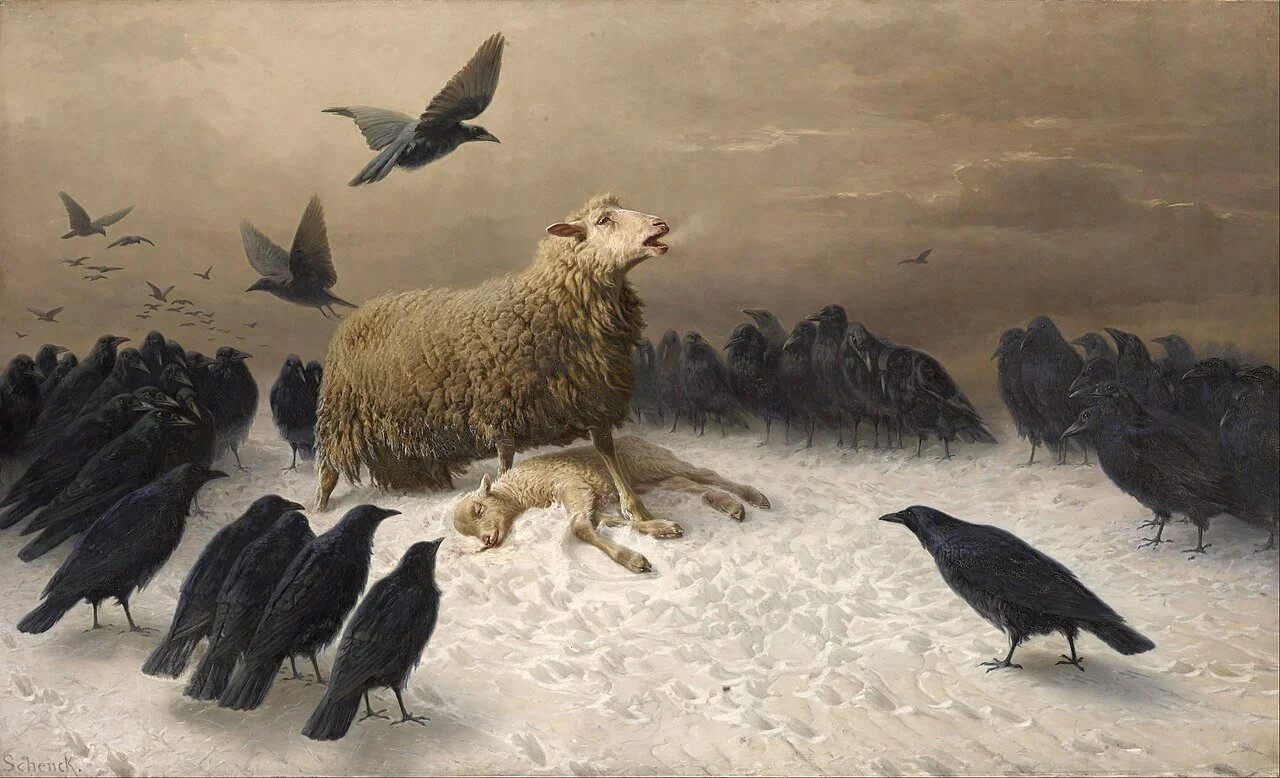
August Friedrich Schenck. Anguish (Angoisse). c. 1878. Oil on canvas. 151 × 251.2 cm. National Gallery of Victoria, Melbourne.
First exhibited at the Paris Salon of 1878, Anguish now lives in the National Gallery of Victoria in Melbourne — where it has twice been voted the most popular work in a collection of 75,000. Once in 1906. Once again, over a century later, in 2011. That kind of endurance isn't sentiment. That's a painting that keeps telling the truth.
The Artist
Schenck's life reads like it was written to make a point about perseverance. Born in 1828 in Glückstadt, a small town in Holstein, then under Danish control, he had no obvious path to the Paris art world. As a young man he spent years working as a wine trader, travelling through Germany, Russia, and Portugal, before eventually arriving in Paris and enrolling at the École des Beaux-Arts under the painter Léon Cogniet.
That late start seems to have sharpened something in him. He became a dedicated, serious painter of animals and landscapes, and for over thirty years he showed regularly at the Paris Salons. By the height of his career, he and Rosa Bonheur were considered the two most celebrated animal painters in Europe, their work collected internationally, their names well known.
He was knighted into the Legion of Honour in 1885. He died in Écouen, the small artist's colony north of Paris where he had settled with his wife, on New Year's Day 1901.
What I find quietly compelling about Schenck is that he came to painting through a side door, and then committed to it completely. A critic writing in Le Figaro in 1878, the same year Anguish was shown, described him as "one of our finest animal painters. One of those originals of the species not yet extinct who prefer dogs to men and find more sweetness in sheep than women." It was meant as a compliment. And honestly, looking at Anguish, it lands as one.
What You're Looking At
The scene is winter. Snow covers the ground — cold, flat, unforgiving. In the centre of the composition, a ewe stands over the body of her lamb. The lamb is dead. A thin line of blood runs from its mouth into the white snow beneath it.
The ewe's head is thrown back, her mouth open. She is calling out, bleating into the grey air, her breath freezing as it leaves her. She is not running. She is not retreating. She is standing directly over her lamb, body braced, completely exposed, facing what is coming.
And what is coming is a circle of crows.
Dozens of them. They crowd around the pair in a dense, pressing ring, black against the white, patient and organised in a way that feels almost deliberate. More arrive in the distance, dark shapes moving through a sky the colour of old pewter. They are waiting. They know they have time.
The painting is large, over two and a half metres wide, and that scale matters. You don't look at Anguish from a safe distance. It pulls you in until you feel like you're standing in that field.
The Emotional Architecture
What makes this painting so devastating is how carefully it is constructed to offer you no escape.
Your eye goes first to the ewe, because she is the lightest thing in the painting, her pale wool luminous against the snow, her face upturned. Then it drops to the lamb. Then it finds the blood. That thin red line in all that white is like a door slamming. Once you've seen it, the painting changes register entirely.
The crows don't rush. That is the detail that stays with me. They are not attacking, they are waiting. And in that patience there is something almost worse than violence. The ewe can hold them off for now. But she cannot hold them off forever. The painting traps you in that moment of terrible suspension: the loss has already happened, and what comes next is inevitable, and the only thing standing between the lamb and that inevitability is a single animal who refuses to accept it.
Schenck places you, the viewer, in an uncomfortable position too. The gap in the ring of crows at the front of the painting, the space between them, draws you in as if you are part of the circle. An observer. A witness. Perhaps complicit.
The Human Underneath
Schenck never pretended this was only about sheep.
His animal paintings were understood by his contemporaries as examinations of the human condition, that was part of what made them resonate so strongly at the Salon. The NGV's own notes describe the surreal massing of the crows as potentially alluding to "the inhumanity prevalent in society." The ewe's expression — open-mouthed, defiant, raw — was noted even in 1878 as carrying unmistakably human characteristics: determination, grief, and a kind of terrible dignity.
The compositional echo of the Pietà has been noted by several writers, and I think it's impossible to unsee once you know it. Mary holding Christ. A mother holding her child. The pose of the lamb, limp, its weight surrendered entirely to gravity, is the same. It's not subtle, and I don't think it was meant to be.
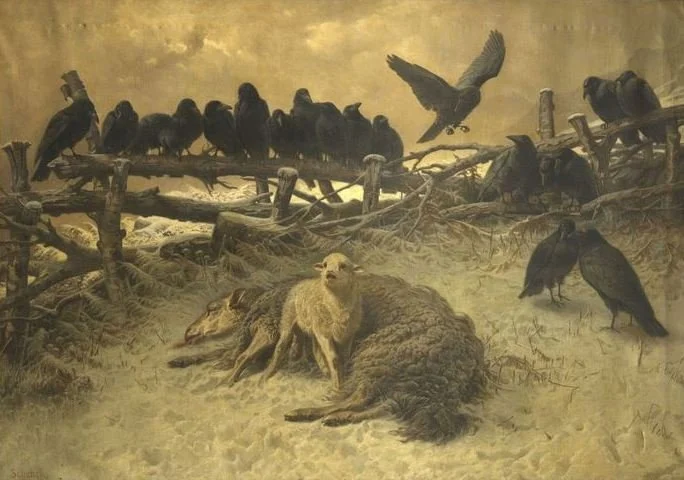
August Friedrich Schenck. The Orphan (L'Orphelin). c. 1885. Oil on canvas. Musée d'Orsay, Paris, France.
There's something else worth sitting with: Schenck made a companion piece to Anguish around 1885, called L'Orphelin (The Orphan), now in the Musée d'Orsay. In that painting, the positions are reversed, a lamb stands over the body of its dead mother, a line of crows waiting on a fence behind it. The same loss, seen from the other side. Together the two paintings feel like a diptych of grief: the parent who stays, and the child left behind.
The Painting as Object
As a conservator, I find myself thinking about the physical life of this painting alongside its emotional one. Anguish retains its original gilt Salon frame, a substantial, cast and gilded frame intended to create the impression of solid metal, scaled to match the grandeur of the work itself. The NGV acquired it in 1880, just two years after it was shown in Paris, for £1,200 — a significant sum that reflects how seriously it was regarded even then.
The painting has been with the same institution for nearly a hundred and fifty years. It still has the frame it wore when it stopped visitors in their tracks at the Paris Salon. There's something right about that continuity, that the physical object has been so carefully preserved alongside the emotional one.
Why It Stays With You
I chose this painting for this series because I wanted to write about something that I find genuinely difficult to look away from — and Anguish qualifies more than almost anything else I can think of.
It doesn't ask anything complicated of you. It doesn't require historical knowledge or artistic literacy. It just shows you a mother who has lost her child, and refuses to leave her, and asks you to sit with that for a moment. In a field in winter. Surrounded by crows.
The title gives you the word before you've even looked. Anguish. And then the painting makes you feel exactly what the word means — not as an idea, but as something physical, something that lands in the body before the mind has caught up.
That, for me, is what painting at its most powerful can do. Not illustrate emotion. Produce it.
If there's a painting you'd like me to look at in a future edition of Behind the Painting, I'd love to hear about it — drop a comment below or get in touch.