Sixty years after the Arno burst its banks, one of the paintings it damaged is only now going back to the conservation studio.
On the morning of 4 November 1966, much of Florence was not at work. It was Armed Forces Day, a public holiday marking Italy's victory in the First World War, and shops and offices were shut. That small accident of the calendar probably saved lives. It also meant that when the Arno broke its banks after days of heavy rain, the doors of many libraries, churches and workshops stayed locked while the water rose inside them.
By the time it began to fall that evening, the river had reached more than six metres in parts of the Santa Croce district. Heating oil from ruptured tanks had mixed with the water, mud and sewage, and roughly 600,000 tonnes of the resulting sludge were left across the city. Thirty-five people died in Florence. Between three and four million books and manuscripts were damaged, along with some fourteen thousand movable works of art.
Sixty years on, the flood is remembered as a catastrophe for Florence's heritage. It deserves to be remembered as something else too, because the response to it helped turn conservation into the profession it is today.
A laboratory under water
Some of the worst damage fell on the very people meant to repair it. At the Uffizi, the restoration laboratories and the photographic department were housed on the ground floor, in rooms known as the Vecchia Posta. More than twenty thousand photographic negatives went under water, and the archive shelves were submerged to a height of 1.5 metres. The man who directed both departments, Umberto Baldini, would spend the following decade at the centre of the recovery.
The most famous casualty was the great painted Crucifix in Santa Croce, attributed to Cimabue and made around 1265. It had survived floods in 1333 and 1557, but in 1966 it hung in the refectory museum, lower and nearer the river than the church itself. The water soaked it in mud and naphtha, the timber swelled and bent, and when the flood receded it took paint with it. Around 60 per cent of the painted surface was lost.
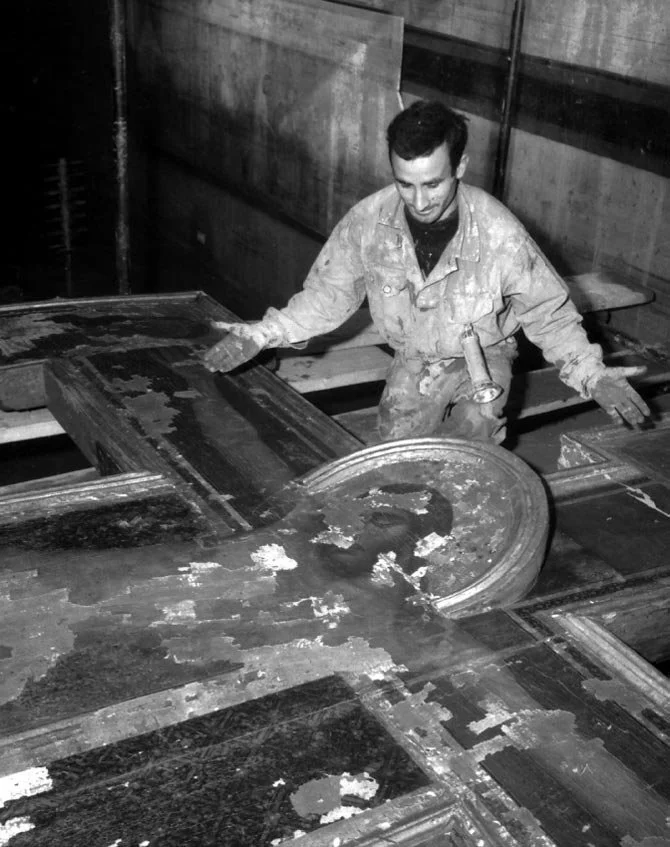
Baldini and Ornella Casazza led a team that worked on the Crucifix for ten years, returning it to display in 1976. They did not try to repaint what had gone. The losses were filled using a form of tratteggio (fine, visible strokes of pure colour), developed into what Baldini's circle called chromatic selection and abstraction, so that from a distance the eye reads the image as whole while, up close, the restoration remains honest about what is original and what is not. Whether the result is beautiful is still debated. That it was principled is not. The Crucifix became a kind of manifesto, proof that a work could be made legible again without being falsified.
Drying out slowly
Panel paintings are wood, and wet wood that dries too fast shrinks, warps and splits, tearing the paint and ground away with it. So the first priority was not cleaning but patience. Panels were taken to the Limonaia, the lemon house in the Boboli Gardens, where the temperature and humidity could be held steady and the drying slowed down. Canvases went to the Accademia, furniture to the Pitti Palace and the Villa della Petraia, sculpture and objects to the Palazzo Davanzati, and books to the Forte Belvedere. After months of monitoring, many works were treated in new laboratories set up in the Fortezza da Basso, a sixteenth-century fortress that still houses part of Florence's state conservation service.
Libraries faced the same problem at a staggering scale. At the National Central Library, around 1.3 million items were damaged. Volunteers washed, disinfected and interleaved books with blotting paper, and dried them in tobacco kilns where the humidity could be brought down gradually. The British book conservator Anthony Cains was appointed the library's technical director of conservation in 1967 and stayed for six years, and Peter Waters was among the specialists who came to help. The work gave the profession ideas it still uses, among them phased conservation and mass deacidification. As the archivist Paul Conway has put it, many changes in professional practice can be traced back to the work of recovery.
The people who carried out much of this labour were not professionals at all. Students and volunteers from across Italy and abroad shovelled mud, carried books and pulled objects out of flooded rooms. Florentines called them the angeli del fango, the mud angels, and the name has stuck.
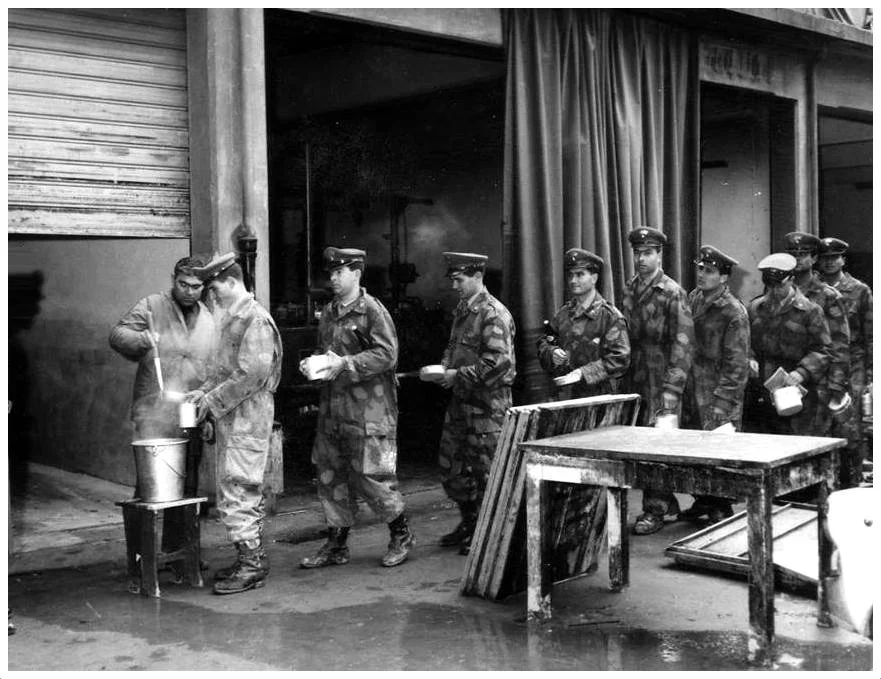
Mud angels in November 1966. Wikimedia Commons.
Building an institution
Florence already had a pioneering restoration laboratory. Ugo Procacci had founded the Gabinetto dei Restauri in 1932, and it was one of the first in the world to use scientific examination, such as X-radiography, before treatment. The flood swamped it with work, some of it enormous (the Cimabue Crucifix measures almost four and a half metres tall), and money and expertise arrived from around the world. In 1975 the Gabinetto was merged with the much older Opificio delle Pietre Dure, the Medici workshop founded in 1588 for inlaid hardstone, to form the modern Opificio. It is now one of Italy's two state conservation schools and among the most respected conservation institutes anywhere. In a very real sense, the flood built it.
Fifty years for a Last Supper
Some works took decades. Giorgio Vasari's Last Supper, painted in 1546 on a large multi-panel poplar support, spent around twelve hours submerged, and many thought it was beyond saving. It waited until techniques for stabilising large, flexible panels caught up. With support from the Getty Foundation's Panel Paintings Initiative, the Opificio finally treated it, and it went back on display in Santa Croce on 4 November 2016, exactly fifty years after the flood.
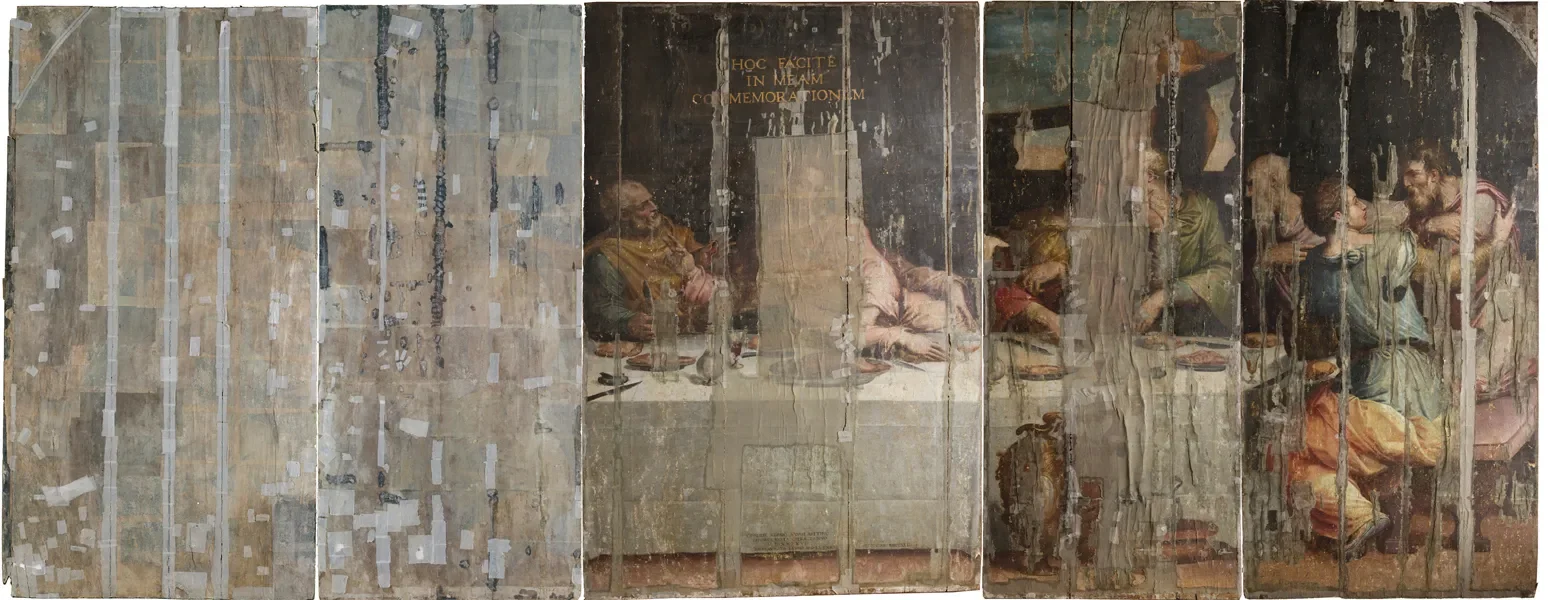
Giorgio Vasari’s Last Supper Painting before the restoration. Iamge from WWD.
And one still waiting
Which brings us to the anniversary. Francesco Botticini's Saint Sebastian, a panel painted around 1475 to 1480 and owned by the Uffizi, had arrived in the Vecchia Posta laboratory in 1963 for a routine review. It was there when the water came in. Mud worked its way even into the old woodworm channels, and as the wood shrank it lost the surface the paint needed to hold on to. In March 1967 a commission of experts decided on a drastic measure, transferring the paint layers to a new support and removing the original wood, with help from the American Committee to Rescue Italian Art. The painting went to the Fortezza da Basso that June and has been in the care of the Opificio ever since.
Now, sixty years on, it is to be restored at last. The Officina Profumo-Farmaceutica di Santa Maria Novella is sponsoring the work, and until 22 November 2026 the painting is on show at the Officina's premises at Via della Scala 16 in an exhibition called Frammenti non dimenticati. Firenze, 1966. When the work is done it will return to the Uffizi. As La Nazione reported, the alterations it suffered will remain, at least in part, in its visible history.
That seems to me the right note on which to end. Transfer was the best answer available in 1967, and conservators today would reach for it far more reluctantly, because it removes so much of what makes a panel painting a physical object. But no one now can give the Saint Sebastian its original wood back. What a modern restoration can do is make the painting readable again while being candid about what happened to it, much as Baldini tried to do for the Cimabue. The flood is now part of this painting's history, and an honest restoration will not pretend otherwise.
The mud angels, after all, were not trying to make Florence look as though nothing had happened. They were trying to make sure something survived.