Every conservator has been asked about it. At dinner parties, on placements, in the comments under almost any post about restoration, someone will eventually mention the monkey. It is the most famous restoration in the world, and it was not done by a restorer.
In August 2012 photographs of a small painting of Christ in a church in Borja, in north-eastern Spain, went round the world. A face that had once been a conventional, rather gentle devotional image had become something else entirely, a round, blurred, bewildered face that the internet quickly named Ecce Mono, "Behold the Monkey" [1]. It has been a meme ever since. But it began as a real painting, made by a real artist, and its story says more about the care of our heritage than any joke.
The Painting
Ecce Homo, "Behold the Man", was painted around 1930 by Elías García Martínez, who taught at the School of Art in Zaragoza and spent his holidays in Borja. It is small, about 50 by 40 centimetres, and was painted directly onto the wall of the Sanctuary of Mercy, a church on the edge of the town that belongs to the Diocese of Tarazona [1]. He gave it to the town, and described it as "the result of two hours of devotion to the Virgin of Mercy" [1].
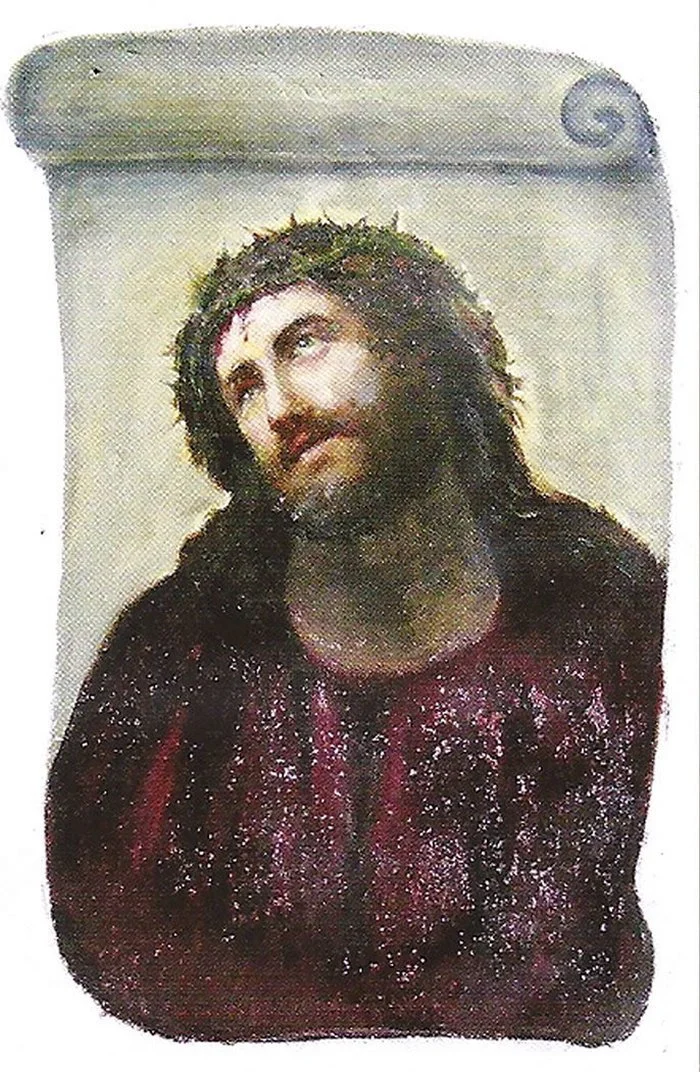
Elías García Martínez, Ecce Homo, about 1930, Sanctuary of Mercy, Borja, photographed before 2012, with paint losses caused by damp in the wall. Image, Wikimedia Commons, public domain
It shows Christ crowned with thorns, eyes raised, in the tradition of the Ecce Homo, the moment in the Gospel of John when Pilate presents the beaten Christ to the crowd. It was never meant to be a masterpiece. It was a sincere, competent devotional image in a local church, the kind of painting that exists in their thousands across Europe and that very few people outside the parish ever think about.
What Went Wrong Before Anyone Touched It
The part of the story that rarely gets told is that the painting was already in trouble. By the 2000s, damp in the church wall had caused the paint to flake away [1]. Photographs taken before 2012 show the losses clearly, especially across the robe.
That matters, because it is where the real conservation problem lay. Paint on a wall is only as stable as the wall beneath it. When moisture moves through plaster it carries salts with it, and as it evaporates at the surface those salts crystallise and push the paint off. Retouching the losses without dealing with the damp would have been, at best, temporary. Any proper treatment would have started with the building.
The Restoration
Cecilia Giménez, a parishioner then in her early eighties and an amateur painter, decided to do something about it. By her account she worked with the knowledge of the local priest, in daylight, and the painting was unfinished when the world saw it. She had let the paint dry and gone away for a couple of weeks, intending to continue [1].
What she had done was paint over the damaged areas, and then over much of the face, in her own hand. The delicate modelling of García Martínez's face disappeared beneath broad, thick strokes, and the image that emerged was no longer his. When the result was discovered, the authorities first suspected vandalism [1]. Then the photographs reached the internet.
The reaction was enormous. The BBC's correspondent described it as resembling "a crayon sketch of a very hairy monkey in an ill-fitting tunic" [1]. The artist's family, who still lived in Zaragoza and had recently given money towards a proper restoration, were distressed. Giménez herself suffered badly from the ridicule, and was reported to have stopped eating [1].
The Monkey That Saved a Town
And then something strange happened. People came to see it. In the first year alone there were around 40,000 visits, raising more than €50,000 for a local charity [1]. The church began to charge a small fee. An interpretation centre about the painting opened in Borja on 16 March 2016 [1][2]. In 2013 Giménez reached an agreement with the town giving her 49 per cent of the profits from merchandise using her version of the image [1]. There have been documentaries, and in 2023 a comic opera about the affair opened in Las Vegas [1].
Giménez, once mocked, became something of a local heroine, and she was still associated with the painting when she died on 29 December 2025, aged 94 [3].
The Conservator's Problem
It would be easy to tell this as a funny story with a happy ending. But it is also the clearest possible illustration of why conservation is a profession.
A trained conservator approaching that wall would have started by asking why the paint was failing, not by reaching for a brush. They would have recorded its condition with photographs, investigated the damp, consolidated the flaking paint so that what survived stayed attached, and only then considered retouching the losses. And that retouching would have been confined to the losses themselves, matched to the surrounding paint, and made with materials that could be removed again in the future without harming the original. Nothing of García Martínez's own surface would have been covered.
None of this is glamorous, and almost none of it would have produced a dramatic before and after. That is rather the point. Good restoration is meant to go unnoticed.
It would also be a mistake to imagine this was simply one well-meaning woman's error. In 2020 a privately owned copy of a Murillo painting in Valencia was disfigured after its owner paid a furniture restorer €1,200 to clean it, and Spanish conservators pointed out, once again, that there was no law stopping people without the necessary skills from restoring works of art [4]. Borja made the problem famous. It did not make it go away.
What Is the Painting Now?
Here is the question I find most interesting. Could the Ecce Homo be restored back to García Martínez's version? Possibly, in part, though removing one layer of paint from another on a damp, fragile wall is delicate work, and some of the original was already lost before 2012. But should it be?
The town has, in effect, already decided. The painting has not been altered since Giménez stopped work [1], and what visitors travel to Borja to see is not García Martínez's Christ but hers. Her intervention, however unwelcome, is now part of the object's history, and part of the history of the town. To strip it away would be to erase the very thing that made it matter to millions of people.
That is a strange conclusion for a conservator to reach, because it runs against almost everything we are trained to do. But conservation has always been about deciding which parts of an object's story to keep. In most cases that means protecting the artist's work from later additions. In this one, uniquely, the later addition has become the work.
What it should never be is a model. For every painting that becomes a tourist attraction by accident, there are thousands of family portraits, parish paintings and treasured pictures quietly damaged in the same way, by kind people with the wrong materials, and nobody ever finds those funny.
References
[1] Wikipedia, 'Ecce Homo (García Martínez and Giménez)' (read 16 November 2026), drawing on Spanish and international press coverage. https://en.wikipedia.org/wiki/Ecce_Homo_(Garc%C3%ADa_Mart%C3%ADnez_and_Gim%C3%A9nez)
[2] 'Celebrating the botched fresco: Spanish town Borja opening new centre', CBC News, 2016. https://www.cbc.ca/news/entertainment/botched-fresco-new-centre-1.3493556
[3] 'Cecilia Giménez, the artist who "restored" the face of Jesus, has died at 94', NPR, 30 December 2025. https://npr.org/2025/12/30/nx-s1-5661514/cecilia-gimenez-dead-artist-jesus-fresco
[4] 'Botched art restoration prompts conservation experts to call for regulation', The Irish Times, June 2020. https://www.irishtimes.com/culture/art-and-design/visual-art/botched-art-restoration-prompts-conservation-experts-to-call-for-regulation-1.4286309