A new imaging study shows how conservators might see exactly how much varnish is left on a painting, and a violin, without touching either.
Every conservator who has cleaned a painting knows the question that hangs over the work. How much is left? Varnish is applied to protect a painting and to saturate its colours, but natural resin varnishes yellow and cloud with age, and later restorers often added layers of their own. Removing them can transform a picture. It is also irreversible. Take off too little and the painting stays veiled. Take off too much, or reach the paint beneath, and the damage is permanent.
For decades the main tool for judging progress has been a lamp. Under ultraviolet light, aged natural varnish glows with a characteristic fluorescence, so conservators check their work by eye in UV, reading the pattern of the glow across the surface. It works, but as a team from King's College London noted in 2023, it depends heavily on the individual and can be inaccurate [1]. That is why a study published this spring in npj Heritage Science caught my attention.
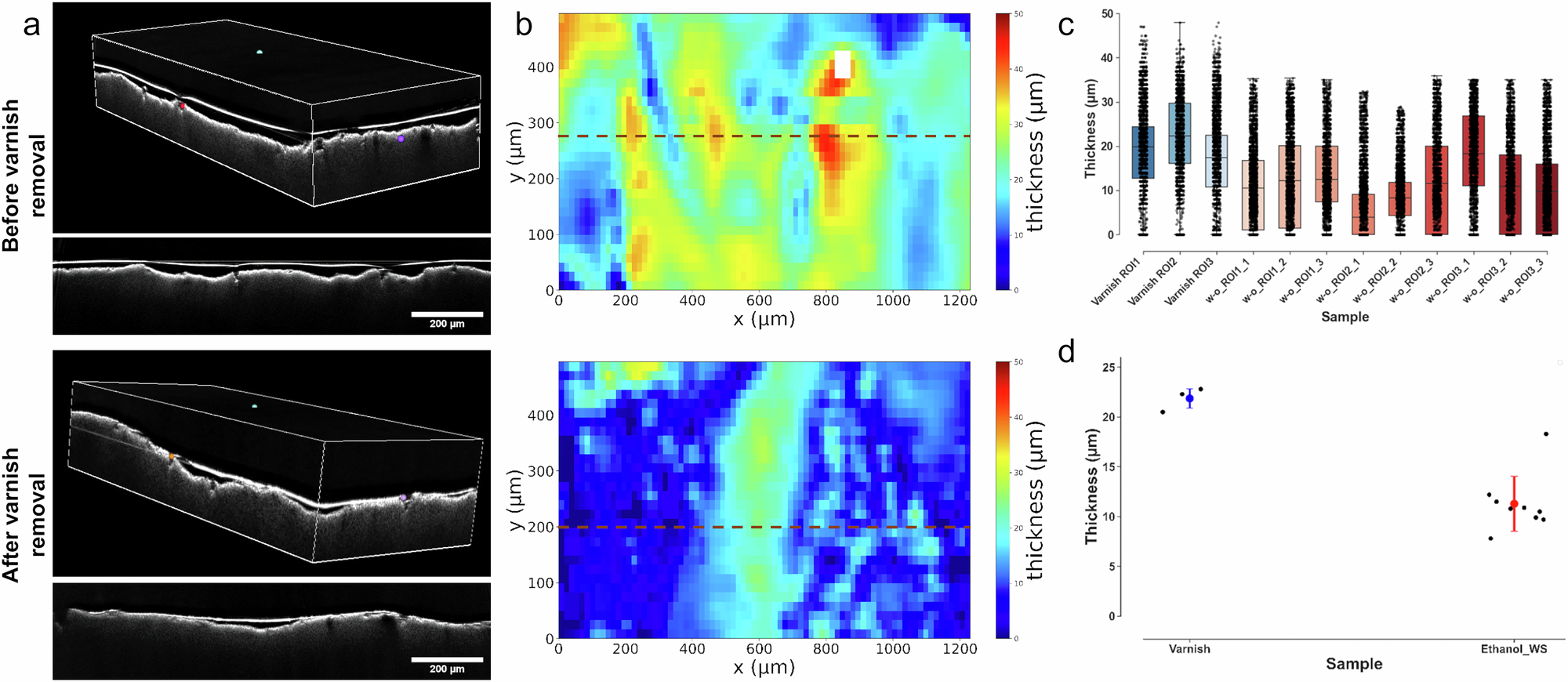
Varnish thickness before and after a cleaning test, measured by LC-OCT. Cross-sections and 3D reconstructions (left) and colour-coded thickness maps (right). From Galante, Vilbert et al., npj Heritage Science 14, 193 (2026), Fig. 3, CC BY 4.0
Seeing in depth
The paper, by Giulia Galante, Gaël Latour and colleagues, uses a technique called line-field confocal optical coherence tomography, or LC-OCT [2]. Optical coherence tomography is already well established in cultural heritage. It works a little like ultrasound, but with light. A beam is directed at the surface, and the light that bounces back from each layer is analysed to build up a cross-section, and then a three-dimensional map, of what lies beneath, without taking a sample or touching the object.
What the new version adds is resolution. LC-OCT combines OCT with confocal microscopy, which focuses on a single thin plane at a time, and the authors report a spatial resolution of around one micrometre, a thousandth of a millimetre, with fast imaging and a penetration depth similar to standard OCT [2]. Varnish layers are often only a few micrometres thick, so that matters. Paired with automated data processing, the method maps varnish layers across an area and measures how they change as a treatment proceeds [2].
In other words, rather than asking whether the glow under the lamp looks even, a conservator could in principle see how thick the remaining varnish is, point by point, and how that changes with each stage of cleaning.
A painting and an Amati
The study tests the method on two seventeenth-century objects [2]. The first is a painting, where LC-OCT was used to document earlier restorations, the kind of detective work that usually relies on cross-sections taken from tiny samples, or on careful reading of UV and other imaging.
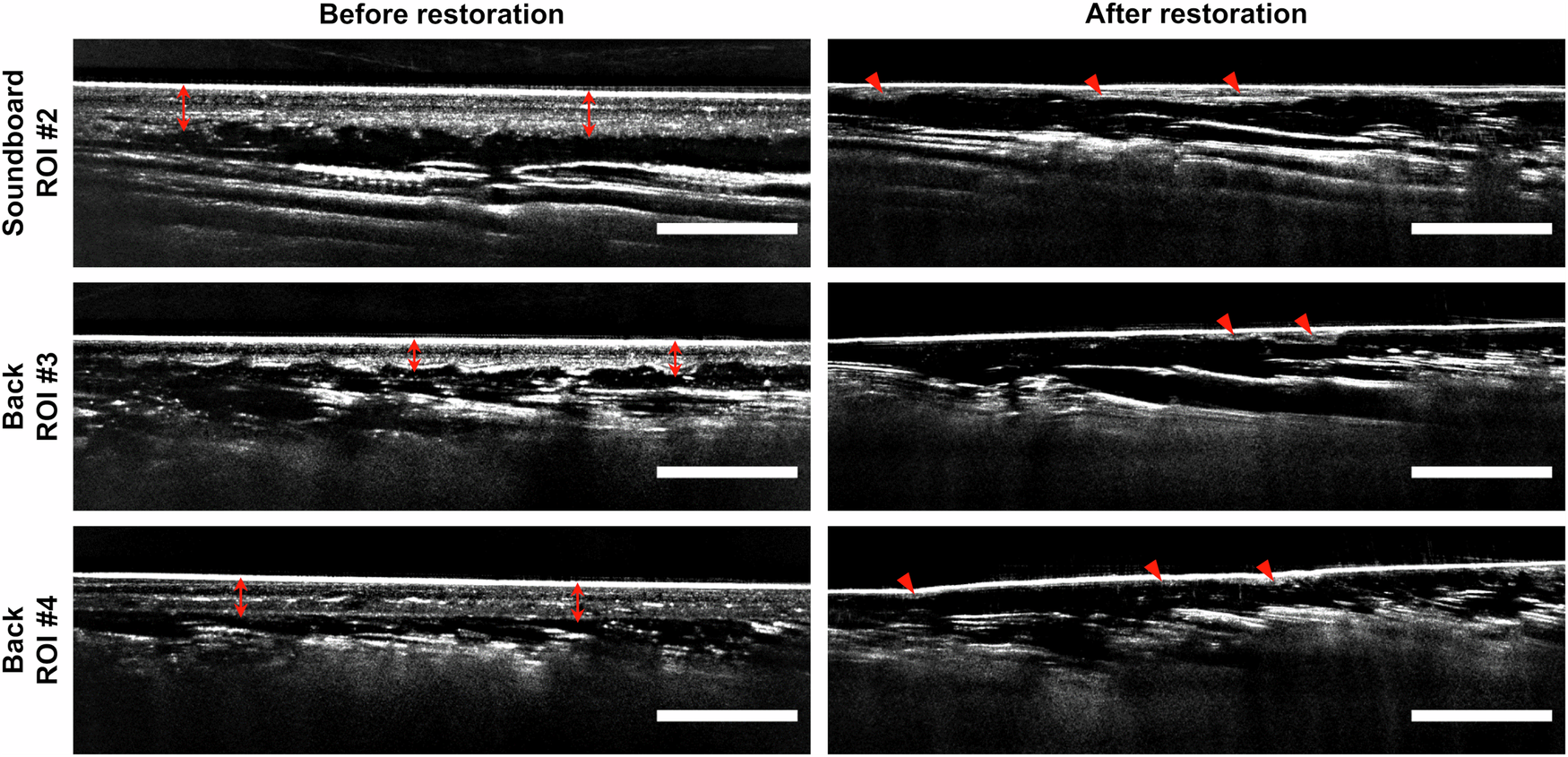
Scans of the same spots on the Amati violin before (left) and after (right) the later varnish was removed. Red arrows mark a thin residue deliberately left in place. Galante, Vilbert et al. (2026), Fig. 5, CC BY 4.0
The second is more unusual. It is a violin by Nicolò Amati, one of the great Cremonese makers, whose instruments are prized in part for their varnish. Here the problem was one every conservator will recognise. The violin's original varnish is unique and must be preserved, but it lies beneath later, non-original coatings that needed to come off. The team used LC-OCT to confirm where the original varnish survived and to guide the selective removal of the layers above it [2]. That is the same dilemma faced in paintings conservation every day, compressed onto a curved, much-handled surface where a single misjudgement could damage an irreplaceable instrument.
How it fits
LC-OCT is not the only new approach to this problem. The King's College team, working with the Courtauld and the University of Edinburgh, developed a camera for fluorescence lifetime imaging (FLIM), which maps where varnish remains across the whole surface of a painting during removal. Professor Aviva Burnstock described it as "paving the way for whole painting imaging during varnish removal" [1]. The two methods seem complementary. Fluorescence lifetime imaging is suited to showing where varnish remains across a surface, while OCT is designed to show the layers in depth, and how thick they are.
Neither replaces the conservator's judgement. Deciding how far to clean is never purely a measurement problem. It depends on the painting's history, the artist's intentions, the condition of the paint and the look of the picture as a whole. Some varnish may be original, some may be protecting fragile glazes, and some may simply be part of how a painting has been seen for centuries. A precise map of what is there does not tell you what ought to stay.
What better measurement can do is take guesswork out of the parts of the decision that ought to be measurable. A conservator who knows that a layer is three micrometres thick here and one micrometre there is in a far stronger position than one judging by the evenness of a glow, and the record of those measurements, kept alongside the treatment report, would be a gift to whoever next works on the painting.
There are practical questions too. Equipment like this is expensive and specialised, and for now it is far more likely to be found in national institutions and research laboratories than in private studios. But many of the techniques now routine in conservation began in exactly that way. If LC-OCT follows the same path, the question hanging over every cleaning, how much is left, may one day come with a number attached.
References
[1] King's College London, 'Physicists paint a bright future for art conservation with revolutionary new camera', 26 June 2023, reporting work published in Heritage Science. https://www.kcl.ac.uk/news/physicists-paint-a-bright-future-for-art-conservation
[2] Giulia Galante, Maëlle Vilbert, Laetitia Desvois, Diane Le Corre, Lou Archambault, Laurianne Robinet, Nicolas Saumagne, Marie-Claire Schanne-Klein and Gaël Latour, 'Non-invasive quantitative investigation of varnish stratigraphy in historical artifacts using line-field confocal OCT', npj Heritage Science 14, article 193 (28 March 2026), doi:10.1038/s40494-026-02460-4. Open access, CC BY 4.0. https://www.nature.com/articles/s40494-026-02460-4